

Cloud security teams rarely have a shortage of findings. The harder problem is deciding which ones deserve attention first.
A CNAPP can surface vulnerabilities, cloud misconfigurations, exposed services, risky identities, container issues, Kubernetes weaknesses and application findings across a large environment. If every issue is presented as another item in a long queue, security teams are left with a prioritization problem rather than a visibility problem.
Sorting by severity helps, but it is not enough. A Critical vulnerability on an isolated development system may be less urgent than a High-severity issue on an internet-facing production workload with sensitive data behind it.
Effective CNAPP alert prioritization therefore needs more than a severity score. It needs exploitability, exposure, asset importance, business context, attack-path relationships and a clear understanding of which remediation will remove the most risk. AI can make that process faster, but it works best when it sits on top of reliable security context rather than replacing it.
Why CNAPP alert prioritization is difficult
Modern cloud environments generate findings from many layers at once. A single organization may scan cloud accounts, source code, containers, Kubernetes clusters, applications, APIs and endpoints. Different tools can also identify the same weakness in different ways.
That creates three practical problems:
- Teams can end up reviewing the same underlying issue more than once.
- Scanner severity does not always reflect the importance of the affected system.
- Individual findings can look minor until they are connected to other weaknesses.
The result is often a queue that tells teams what exists, but not what should happen next. This is why prioritization should answer a different question from detection.
Detection asks: “What is wrong?”
Prioritization asks: “What creates the most meaningful risk to this organization right now?”
Severity alone does not tell you what matters most
CVSS and scanner severity are useful starting points because they describe the technical seriousness of a vulnerability. They do not, however, know enough about the environment where that vulnerability exists.
Consider two servers with the same vulnerability and the same CVSS score:
- One sits in a development environment, has no direct internet exposure and holds no sensitive information.
- The other runs a production service, is reachable from the internet and connects to customer data.
Treating those two findings as identical would ignore most of the information that determines real-world risk.
This is increasingly reflected in modern cloud security prioritization. Microsoft, for example, says the Defender for Cloud risk engine considers factors such as internet exposure, data sensitivity, lateral movement, attack paths, exploitability and potential business impact. Severity needs context.
What should a CNAPP use to prioritize findings?
A useful prioritization model combines several signals instead of depending on one number.
Exploitability
A vulnerability that attackers are already using deserves different treatment from one that is only theoretically exploitable.
CISA maintains the Known Exploited Vulnerabilities (KEV) catalog specifically to identify vulnerabilities that have been exploited in the wild, and recommends using it as an input to vulnerability-management prioritization. EPSS adds another signal by estimating the probability that exploitation of a CVE will be observed in the wild over the next 30 days.
Together with public-exploit information, these signals help teams move beyond “How severe is this vulnerability?” toward “How likely is someone to use it?”
Exposure and reachability
Even an exploitable weakness becomes more urgent when an attacker can actually reach the affected system.
Internet-facing workloads, publicly accessible services, exposed storage and reachable vulnerable components should therefore influence priority. Network relationships matter as well: an issue that provides access to other important systems may create more risk than its standalone severity suggests.
Business importance
Technical context needs to be connected to business context.
Production systems usually deserve different treatment from temporary development resources. A customer-facing service may matter more than a low-value internal workload. Systems holding PII, PHI, payment information, intellectual property or other sensitive data can also require higher priority.
Asset ownership matters for a practical reason too. A finding cannot move toward remediation if nobody knows which team is responsible for the affected service.
Confidence
Prioritization should also consider how confident the platform is that the issue is real. A finding supported by multiple scanners, an active cloud-provider detection or other corroborating evidence gives teams more reason to act quickly than a weak signal that still needs investigation.
These factors are most useful when they work together. Exploitability without exposure can overstate urgency. Exposure without asset importance can do the same. Business criticality without technical evidence can push teams toward fixing expensive problems that may not be practically exploitable.
Reduce noise before ranking the queue
There is little value in applying sophisticated risk scoring to a queue filled with duplicates.
Imagine that the same container vulnerability appears across repeated scans, or that multiple tools identify the same weakness on the same asset. If every detection becomes a separate task, analysts spend time repeating decisions rather than reducing risk. A mature CNAPP should therefore normalize and deduplicate findings before asking analysts to prioritize them.
Offload Security uses a shared data layer where findings from cloud, code, containers, Kubernetes, web and API scanning, and supported integrations are normalized into a common model. The same issue remains one record even when it is seen repeatedly or by multiple sources.
Grouping goes one step further. Instead of reviewing every occurrence separately, teams can work from a single item that represents one check across the resources it affects, while still drilling into individual assets when they need different treatment.
In simple terms, deduplication reduces duplicate findings; grouping reduces duplicate decisions.
Prioritize attack paths
Some of the most important cloud risks appear only when several weaknesses are connected.
A publicly exposed workload may have a vulnerability that looks manageable on its own. But if that workload can assume an overprivileged identity, move laterally and reach a sensitive data store, the combined path is far more important than any single finding in isolation. Attack path analysis helps teams see those relationships.
This changes remediation priorities. The best fix may not be the highest-severity item in the path. It may be the control that breaks several paths at once.
Offload Security's Attack Path Analysis, for example, builds relationships between resources, identities, data stores, vulnerabilities, containers and Kubernetes workloads. It then identifies toxic combinations and provides views for choke points, blast radius, root-cause groups and remediation options. Choke points show relationships shared by multiple paths, while root-cause groups cluster findings that share an underlying cause, such as the same CVE or the same misconfiguration repeated across many resources, so one fix covers all of them.
This is an important shift in thinking. The goal is no longer simply to fix the finding at the top of a list. It is to identify the change that removes the most meaningful risk.
Where AI helps with CNAPP prioritization
AI is useful here, but not because every security decision needs to become an AI decision. The biggest value comes from reducing the amount of manual reading and analysis around an already well-structured risk model.
For example, AI can turn several technical signals into a plain-language explanation of why a finding matters. It can summarize what changed in a scan, help an analyst investigate a complicated finding, answer questions about current security posture and draft remediation guidance for review. This is particularly useful for teams that have enough context to prioritize a finding but still need to understand the reasoning quickly.
Offload Security's AI Assistant follows this model. It operates on the same normalized security data used elsewhere in the platform and can explain findings, summarize scan results, suggest fixes and answer security-posture questions. Its output is advisory: actions such as closing a finding, accepting risk, changing a control or executing remediation remain explicit human decisions.
That separation matters because explanation and decision-making have different requirements. AI can make complex information easier to consume, while the underlying prioritization should still be traceable to concrete risk signals.
AI should not become an unexplained risk score
A black-box score can create a new problem: the team receives a priority, but cannot explain why the system produced it. For operational security, consistency and auditability matter. Analysts should be able to see the factors behind a priority and understand what would change the result.
Offload Security takes this approach. Its Triage Engine gives every open finding a deterministic score from 0 to 100. The score combines scanner severity with exploitability signals such as CISA KEV, EPSS and public exploits, as well as internet exposure, environment, asset criticality, sensitive data, confidence and active cloud-provider detections. Findings are then divided into P1 through P4 priorities, with P1 and P2 forming the Action Queue.
AI is not used to calculate this core score. The same inputs therefore produce the same prioritization result, while AI can be used afterward to explain the evidence and help the analyst act on it.
For organizations evaluating AI-driven CNAPP features, this is a useful principle: AI should improve understanding and speed without making risk decisions impossible to inspect.
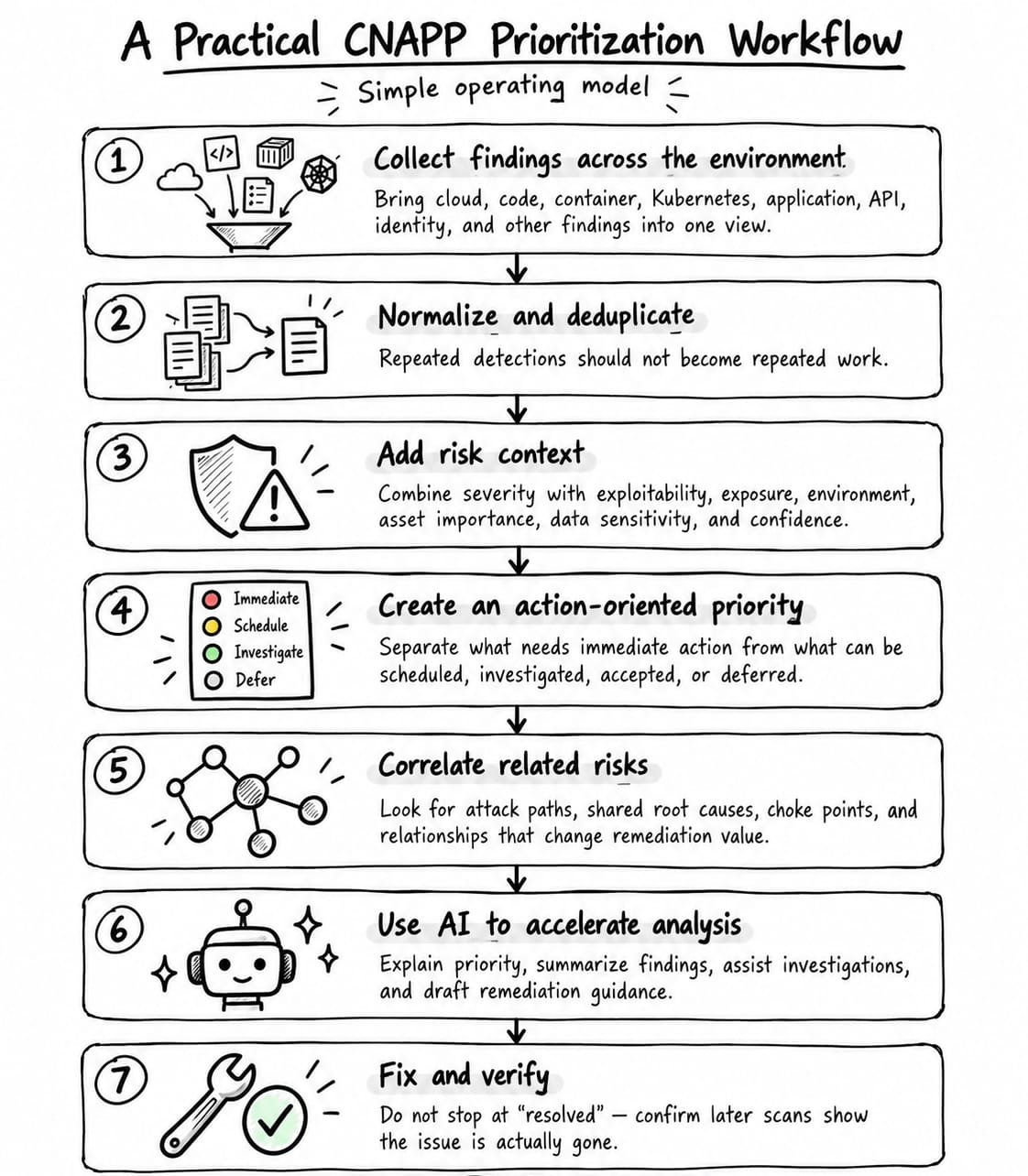
A practical CNAPP prioritization workflow
The ideas above can be turned into a straightforward operating model:
- Collect findings across the environment. Bring cloud, code, container, Kubernetes, application, API, identity and other relevant findings into one view.
- Normalize and deduplicate them. Repeated detections should not become repeated work.
- Add risk context. Enrich technical severity with exploitability, exposure, environment, asset importance, data sensitivity and confidence.
- Create an action-oriented priority. Separate findings that need immediate attention from those that can be scheduled, investigated, accepted or deferred.
- Correlate related risks. Look for attack paths, shared root causes, choke points and other relationships that change the value of a remediation.
- Use AI to accelerate analysis. Explain priority, summarize complex findings, assist investigations and draft remediation guidance.
- Fix and verify. Remediation should not end when someone clicks “resolved.” A later scan should confirm that the issue is actually gone.
That last step is easy to overlook. In Offload Security, a finding that a scan had resolved is reopened if a later scan detects it again, and when a fix pull request opened from the platform is merged, the repository is rescanned and the finding is only marked verified-fixed if the issue is actually gone.
Prioritization is therefore not just a ranking exercise. It is part of a lifecycle that ends only when the risk has been treated and the result verified.
How Offload Security turns CNAPP findings into action
Offload Security provides a useful example of how these ideas can work together inside a CNAPP.
Findings from different security domains flow into a unified data layer and are normalized and deduplicated. The Triage Engine then scores open findings using exploitability, exposure, environment, business importance, sensitive-data context and confidence. P1 and P2 findings go into the Action Queue, while lower-priority findings remain in the backlog for scheduled review.
From there, analysts can evaluate attack paths to understand how findings connect, identify choke points or shared root causes, and focus on fixes that remove multiple paths rather than treating each alert separately. AI can explain why a finding was prioritized and help draft remediation, while the final decision stays with the security team.
This creates a progression from visibility to action:
Findings → normalized risk → priority → attack context → explanation → remediation → verification.
That is ultimately what CNAPP alert prioritization should achieve.
From more findings to better security decisions
The goal of a CNAPP should not be to produce the longest possible list of issues. It should help a team make better security decisions with the information it already has.
A useful prioritization process tells the team what needs attention now, why it matters, what an attacker could potentially reach, which remediation removes the most risk, who owns the work, and whether the problem has actually been fixed.
Severity still matters, but it is only one signal. Exploitability, exposure, business context, data sensitivity, confidence, attack paths and root causes provide the context that turns a finding into a meaningful priority. AI can then make that context easier to understand and act on.
When those pieces work together, CNAPP prioritization stops being about producing a better-ranked alert list. It becomes a way to turn a large volume of cloud security findings into a smaller, clearer set of actions that reduce real risk. To see it on your own environment, book a demo.