
Retire the weekly spreadsheet merge.
Feed every scanner you run — and the tools you already own — into one normalized, de-duplicated queue with ownership, SLAs and history, so your team spends its time reducing risk instead of preparing data.
Start with the pressure you're under today.
Ten consoles, ten dialects
Each scanner has its own severity scale, export format and console. Someone stitches them together by hand before triage can even start.
Duplicates bury the exploitable
The same issue across resources and rescans shows up as dozens of findings, drowning the few that are actually exploited.
One platform, mapped to how you actually work.
One occurrence model
Findings from cloud, code, containers, Kubernetes, web/API and integrated third-party tools normalize into a single occurrence model with canonical severities.
Stable fingerprints, real dedup
Fingerprinting keeps a finding's identity stable across rescans, so duplicates collapse and triage decisions persist instead of resetting each scan.
Exploit-aware prioritization
CVSS is enriched with CISA KEV and EPSS so the queue surfaces what's actually being exploited, not just what scores high in theory.
Every finding, risk and control in one place.
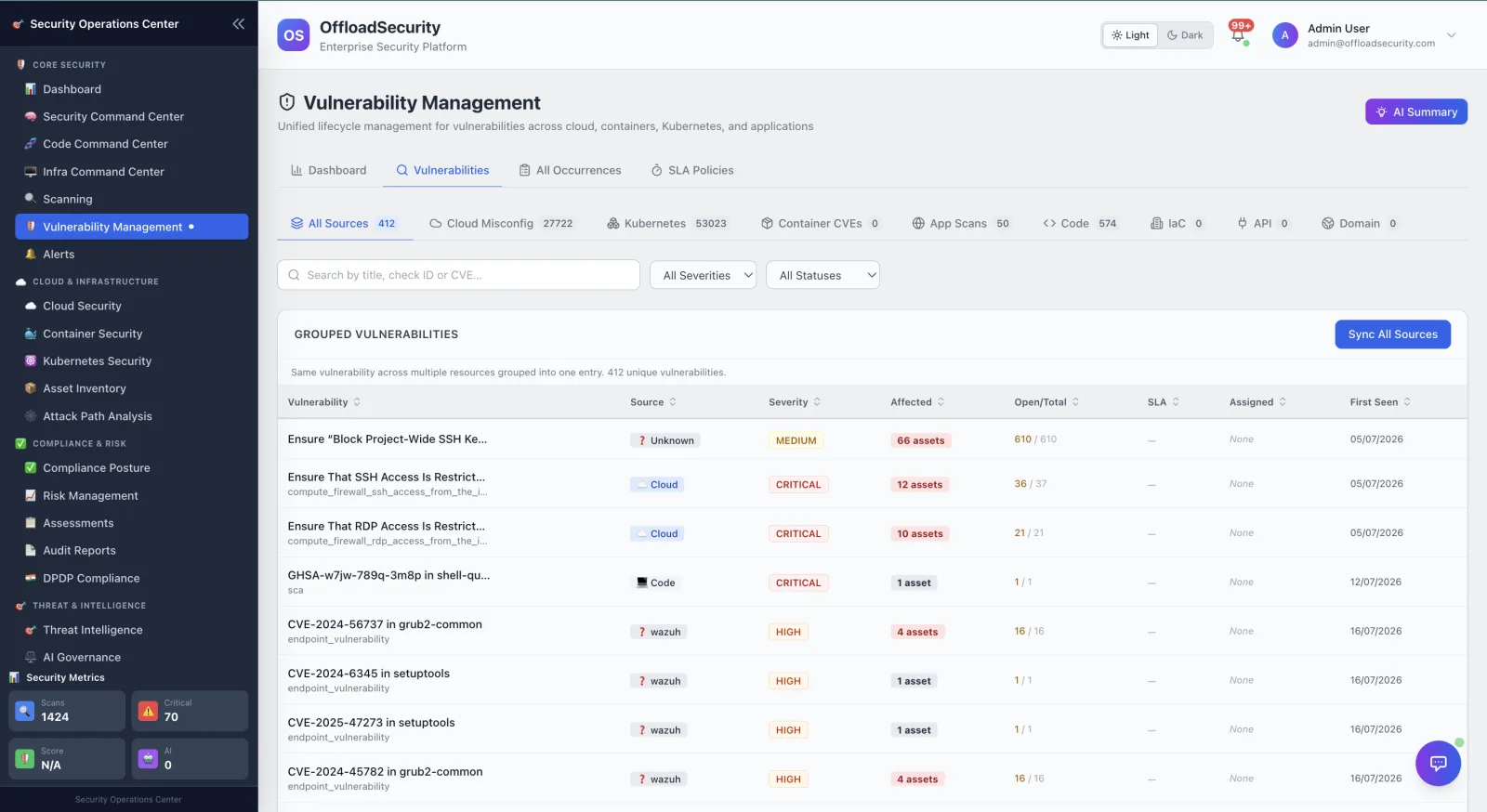
The parts of the platform that carry the load.
What changes with Offload.
- One de-duplicated queue across every scanning domain
- Triage decisions that persist across rescans
- Exploited issues surfaced above theoretical criticals
- The weekly spreadsheet merge, retired
See it on your own environment.
Most teams start with a bounded pilot — a few cloud accounts, repositories and clusters, measured against agreed success criteria.