
Integrations & SIEM
Make the tools you already own more valuable instead of replacing them.
How does Offload Security integrate with existing tools and SIEMs like Wazuh?
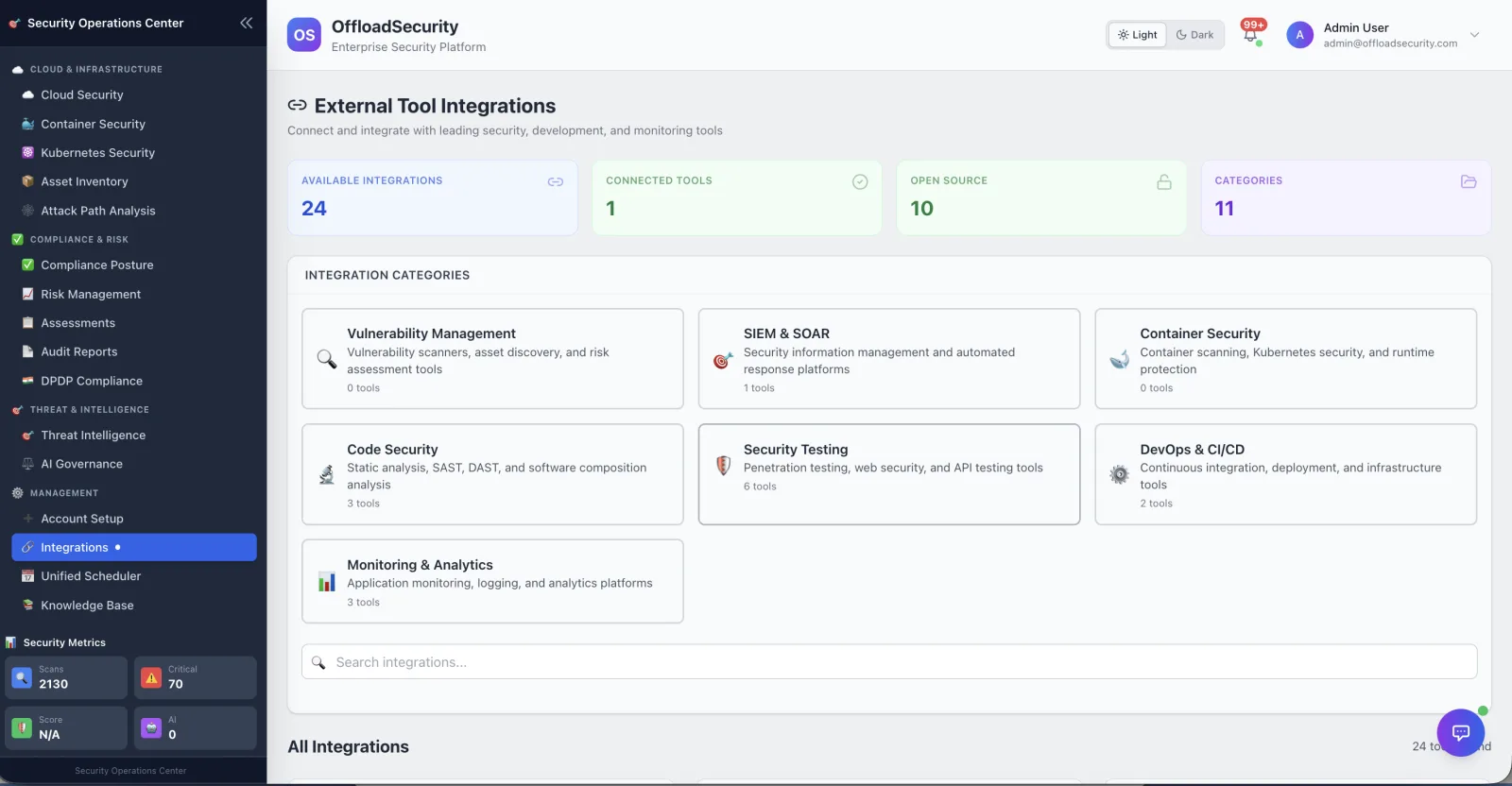
Connects the platform to the tools an organization already runs — SIEM, ticketing, chat, scanners — with team-scoped encrypted credentials, verified connections, and real data ingestion into the unified risk view.
Integrations & SIEM in the Offload Platform
What this replaces
Every security tool added is another console, another credential store, another export. The stack grows; the visibility doesn't.
What Offload does
Connects the platform to the tools an organization already runs — SIEM, ticketing, chat, scanners — with team-scoped encrypted credentials, verified connections, and real data ingestion into the unified risk view.
What you get
- Integration marketplace with connect, test, sync, and disconnect flows
- Team-scoped credential store — encrypted at rest, usable by the whole team, isolated across tenants
- Wazuh SIEM integration: agent inventory, alert ingestion, posture summaries in platform dashboards
- Real connection tests at connect time — not fire-and-forget configuration
- Scheduled global sync with per-integration data summaries and health
- Central alerting for integration failures and high-value events
- Audit and compliance connectors so integrated-tool evidence supports control posture
How it works
Each integration stores configuration with sensitive fields encrypted. Connect and sync execute real tests against the target system with classified results, giving every integration a consistent freshness and health model.
The Wazuh bridge treats the SIEM as a first-class data source: agents and alerts ingested, summarized, and correlated into posture views.
One platform, one risk view
Integrated-tool findings and events join unified vulnerability management and central alerting, extend compliance evidence, and appear in executive reporting.
Ready to implement it?
Step-by-step guides in the product documentation — every connection is read-only, with copy-paste setup.
Solutions built on Integrations & SIEM
Robotics, Logistics & Manufacturing
Cloud workloads, on-premises infrastructure and embedded software supply chains — unified in one governed risk view, with Wazuh/SIEM integration for the operational side and full on-premises deployment for air-gapped environments.
MSSPs & Consultancies
Multi-tenant by design: run each client as an isolated team, standardize your delivery on one platform across cloud, code, containers and compliance, and hand clients executive reporting that maps findings to the frameworks they report on.
Consolidate scanner findings
Feed every scanner you run — and the tools you already own — into one normalized, de-duplicated queue with ownership, SLAs and history, so your team spends its time reducing risk instead of preparing data.
Other modules on the platform
Integrations & SIEM — frequently asked questions
Does Offload Security integrate with Wazuh?
Yes, as a first-class data source: Wazuh agent inventory and alerts are ingested and summarized into platform dashboards and correlated into posture views.
How are integration credentials stored?
In a team-scoped credential store, encrypted at rest and isolated across tenants, with real connection tests at connect time rather than fire-and-forget configuration.
Does Offload replace the security tools I already own?
No — it unifies their findings and events into one operational risk view, making existing tools more valuable instead of replacing them.