
Unified Vulnerability Management
Replace per-tool consoles and spreadsheets with a single governed risk queue.
What is unified vulnerability management, and how does Offload Security do it?
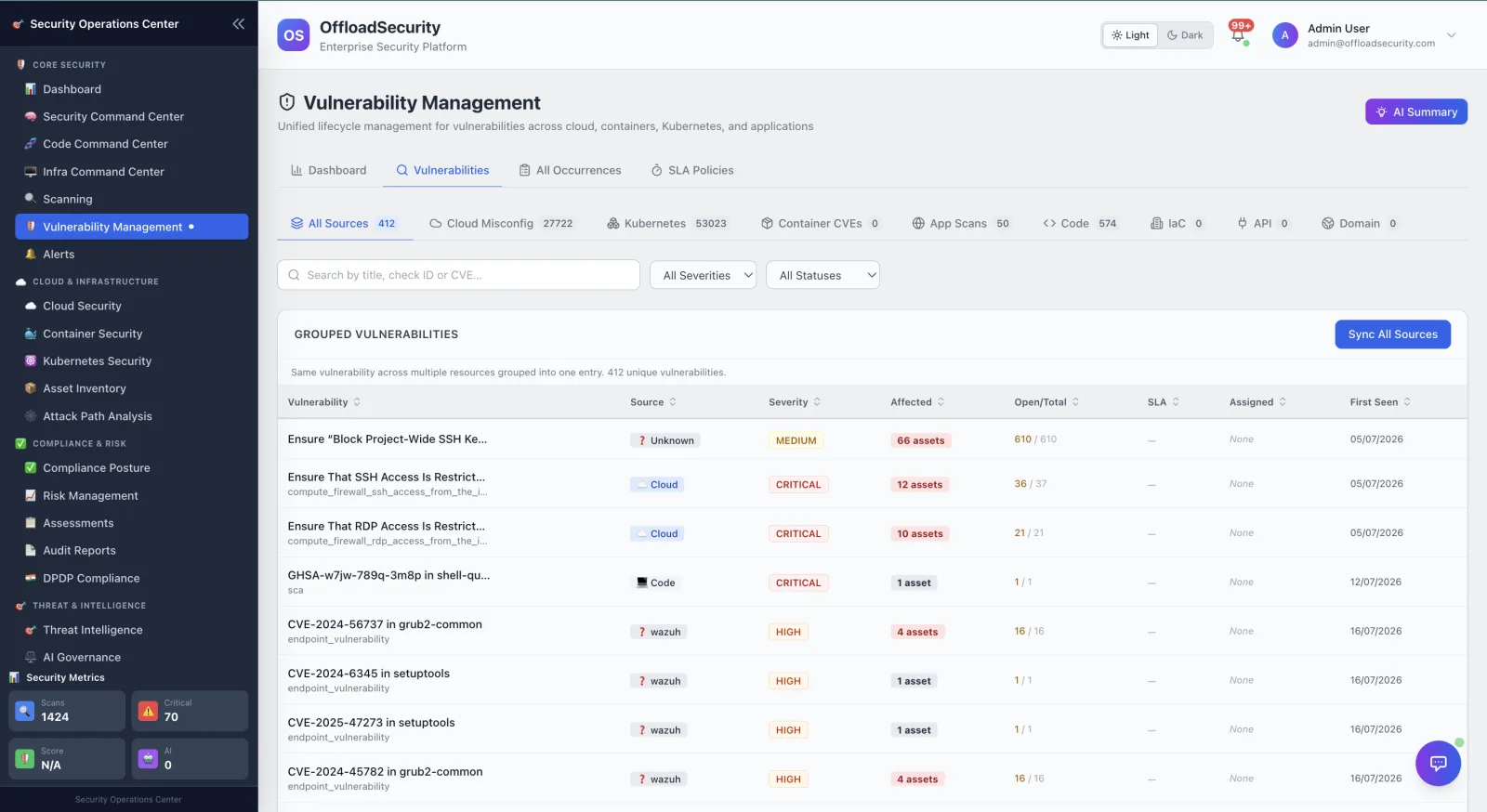
Findings from every scanning module and integrated tool are normalized into a single occurrence model with deduplication, exploit-aware prioritization, governed lifecycle, SLA tracking, and full history.
Unified Vulnerability Management in the Offload Platform
What this replaces
Findings live in ten consoles. Every week someone exports CSVs, de-duplicates by hand, argues about severity, and rebuilds the same spreadsheet — while critical, exploited vulnerabilities wait in the noise.
What Offload does
Findings from every scanning module and integrated tool are normalized into a single occurrence model with deduplication, exploit-aware prioritization, governed lifecycle, SLA tracking, and full history.
What you get
- Single occurrence model across cloud, code, containers, Kubernetes, web/API, and integrated third-party sources
- Canonical severities and stable fingerprints — duplicates collapse across rescans, triage decisions persist
- Exploit-aware prioritization: CVSS enriched with CISA KEV and EPSS exploit probability
- Governed lifecycle: risk acceptance requires owner, justification, and expiry — expired acceptances re-open automatically
- Ownership, SLA tracking, and vulnerability aging measurement
- Occurrences auto-close when their resource is deleted — no zombie findings
- Executive dashboards over live data: counts, trends, aging, SLA posture
How it works
Every scanning module syncs results through one synchronization service that owns the canonical vocabulary — severities, statuses, and source types are defined once. Fingerprinting keeps a finding's identity stable across scans, so re-scans update rather than duplicate.
Read paths are engineered for scale, keeping dashboards responsive as occurrence volumes grow into the millions.
One platform, one risk view
Occurrences mint into the risk register with business context, drive compliance posture, power central alerting, and feed attack-path and threat-intelligence correlation.
Ready to implement it?
Step-by-step guides in the product documentation — every connection is read-only, with copy-paste setup.
Work the unified findings queue →
Deduplication, lifecycle statuses, and P0–P4 priority rank.
Configure remediation SLAs →
Starter policies, breach dashboard, escalation.
Promote findings into the Risk Register →
Owners, treatment plans, and governed acceptance.
Add business context with BIA →
Criticality-weighted risk scoring.
Solutions built on Unified Vulnerability Management
Banking & Financial Services
Consolidate cloud, code, container and Kubernetes risk into one governed view, map it live to the frameworks your auditors and regulators expect, and keep regulated data in your own environment — with a native DPDP Act and CERT-In breach module built for India.
Robotics, Logistics & Manufacturing
Cloud workloads, on-premises infrastructure and embedded software supply chains — unified in one governed risk view, with Wazuh/SIEM integration for the operational side and full on-premises deployment for air-gapped environments.
MSSPs & Consultancies
Multi-tenant by design: run each client as an isolated team, standardize your delivery on one platform across cloud, code, containers and compliance, and hand clients executive reporting that maps findings to the frameworks they report on.
Consolidate scanner findings
Feed every scanner you run — and the tools you already own — into one normalized, de-duplicated queue with ownership, SLAs and history, so your team spends its time reducing risk instead of preparing data.
Automate compliance evidence
Back controls with live technical findings, collect evidence as scans run, and generate audit packs on demand — so your compliance posture reflects the real environment instead of a parallel spreadsheet.
Replace the risk spreadsheet
Score risk on CVSS, EPSS, KEV and business impact, and let risks open and close with the findings beneath them — so the register reflects reality between board meetings, not just before them.
Executive cyber-risk dashboard
One live view of posture across cloud, code, containers and compliance — risk score, top findings, framework coverage and trend — so leadership gets the answer from real data, not a manually assembled deck.
Other modules on the platform
Unified Vulnerability Management — frequently asked questions
How does Offload Security deduplicate vulnerabilities across scanners?
Findings are normalized into one occurrence model with canonical severities and stable fingerprints, so duplicates collapse across rescans and across tools — and your triage decisions persist instead of resetting each scan.
How does Offload prioritize which vulnerabilities to fix first?
It enriches CVSS with CISA KEV (known-exploited) and EPSS exploit probability, plus business context from the risk register — so genuinely exploitable issues rise above theoretical criticals.
What happens to a finding when its resource is deleted?
Occurrences auto-close when their underlying resource is deleted, so you don't accumulate zombie findings for infrastructure that no longer exists.