
Kubernetes Security
CIS, NSA, and MITRE-aligned cluster assessment — automatic from onboarding.
How does Offload Security assess Kubernetes cluster security?
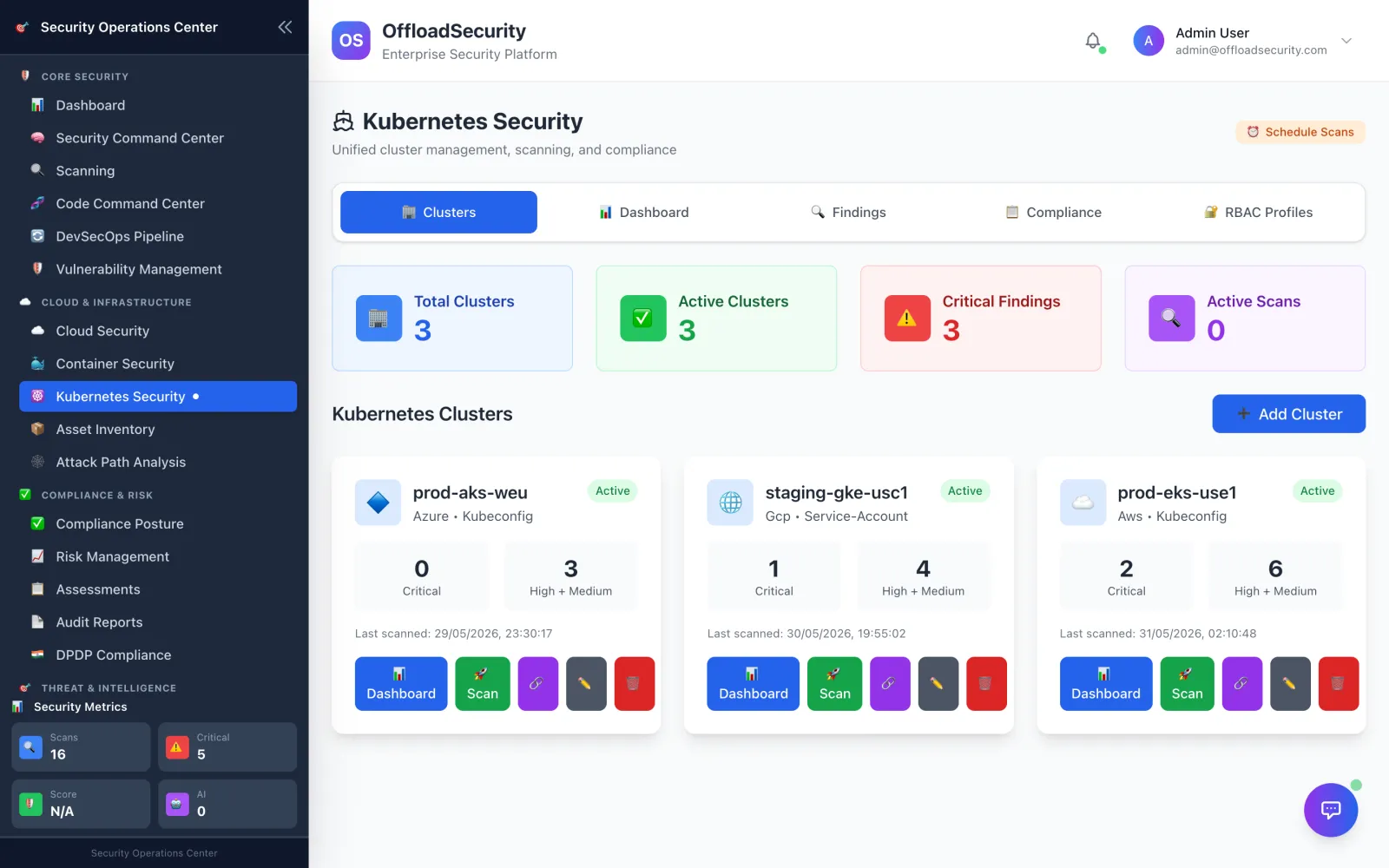
Continuous assessment of Kubernetes clusters — CIS benchmarks, workload best practices, framework-aligned checks, and image vulnerabilities — from a validated, encrypted cluster connection.
Kubernetes Security in the Offload Platform
What this replaces
Kubernetes security is a quarterly manual audit at best: RBAC drift, privileged workloads, and vulnerable images accumulate silently between checks.
What Offload does
Continuous assessment of Kubernetes clusters — CIS benchmarks, workload best practices, framework-aligned checks, and image vulnerabilities — from a validated, encrypted cluster connection.
What you get
- Cluster onboarding with kubeconfig safety validation and encrypted credential storage
- CIS Kubernetes Benchmark (kube-bench) and workload best practices (Polaris)
- Framework-based posture: NSA-CISA, CIS, MITRE ATT&CK-aligned controls (Kubescape)
- Image CVE scanning for workloads running in cluster pods (Trivy)
- Findings tagged with MITRE ATT&CK techniques
- Automatic first scan on onboarding; scheduled recurring scans; live scan status
- Strict per-team cluster ownership on every scan and read path
How it works
Scans run as background jobs: the platform connects to the cluster, executes each scanner in an isolated container, parses results into a common schema, tags MITRE techniques, and persists per-cluster history.
Execution is instrumented end-to-end, with orphaned-scan cleanup and a reconciler so scan status always reflects reality.
One platform, one risk view
Kubernetes findings flow into unified vulnerability management with the same triage lifecycle as cloud and code findings, mint into the risk register, and contribute to compliance posture and reports.
Ready to implement it?
Step-by-step guides in the product documentation — every connection is read-only, with copy-paste setup.
Other modules on the platform
Kubernetes Security — frequently asked questions
Which Kubernetes benchmarks does Offload Security check?
CIS Kubernetes Benchmark (kube-bench), workload best practices (Polaris), NSA-CISA/CIS/MITRE-aligned posture (Kubescape), and image CVE scanning for running workloads (Trivy).
When does the first cluster scan run?
Automatically on onboarding, from a validated, encrypted kubeconfig connection — then on a recurring schedule with live scan status.
Are Kubernetes findings mapped to MITRE ATT&CK?
Yes. Findings are tagged with MITRE ATT&CK techniques and flow into the same unified vulnerability queue and risk register as cloud and code findings.