
Compliance & Risk (GRC)
Compliance that reflects technical reality, not a parallel spreadsheet universe.
What is a GRC platform that connects compliance to live security findings?
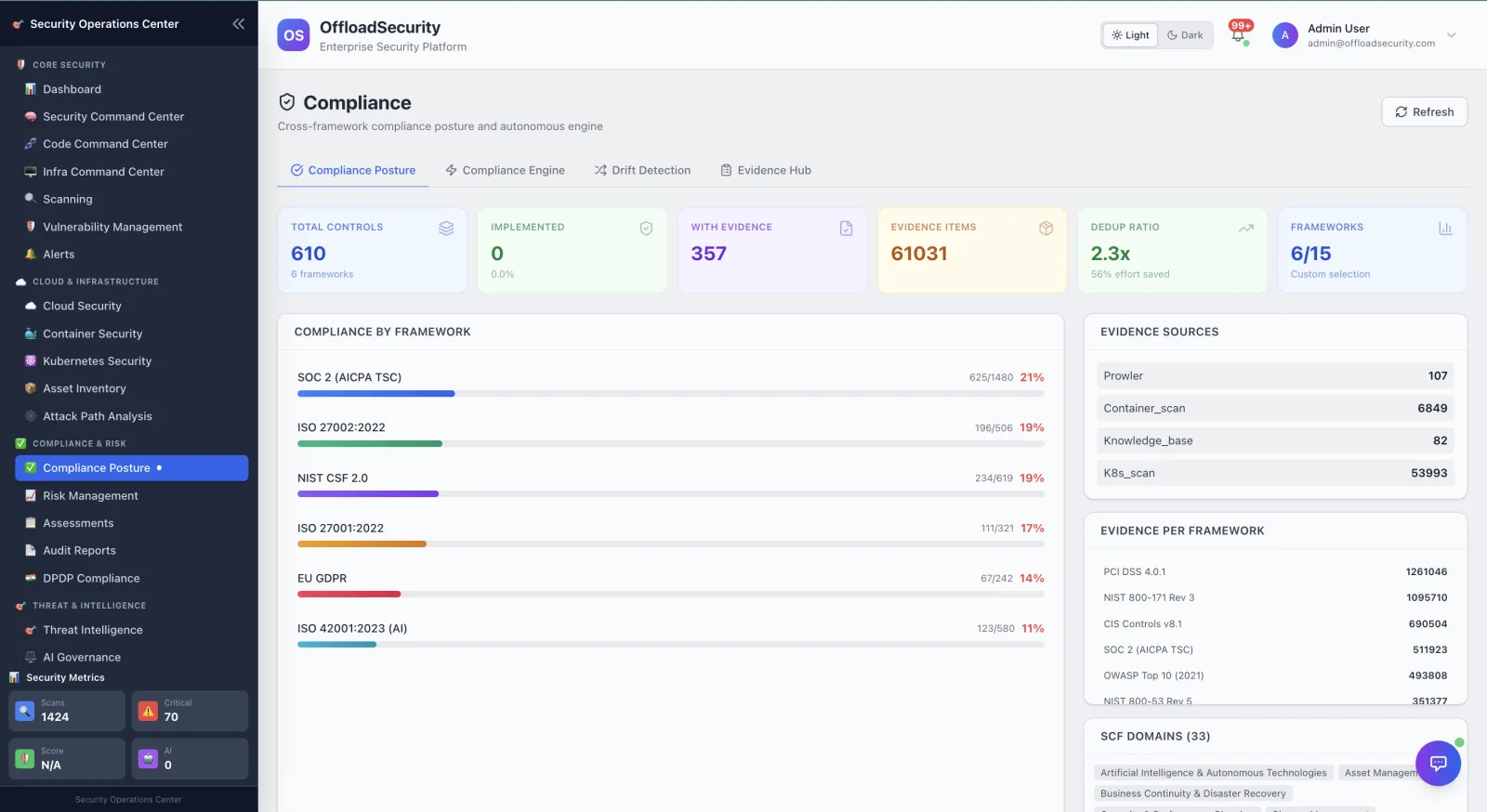
Compliance posture, enterprise risk management, and business impact analysis unified — and wired to the platform's live technical findings, so dashboards, risk scores, and audit evidence reflect the actual environment.
Compliance & Risk (GRC) in the Offload Platform
What this replaces
The risk register is a spreadsheet updated before board meetings. Compliance dashboards say green while the scanner queue says otherwise. Auditors ask for evidence and the answer is a week of screenshots.
What Offload does
Compliance posture, enterprise risk management, and business impact analysis unified — and wired to the platform's live technical findings, so dashboards, risk scores, and audit evidence reflect the actual environment.
What you get
- Framework assessments and control posture: ISO 27001, SOC 2, SCF, and more
- Technical findings mapped to compliance controls — failed controls are backed by the findings that fail them
- Enterprise risk register with composite scoring: CVSS, EPSS, KEV, and business context
- Correlators: attack-path combinations, failed controls, and BIA criticality feed risk scoring
- Treatment plans with SLA escalation; risks auto-close when underlying findings resolve
- Business Impact Analysis: RTO/RPO and financial impact per process
- AI-assisted security-questionnaire answering from an approved knowledge base
- Automated audit, customer, and management reporting
How it works
Correlators bridge compliance posture, attack-path analysis, and BIA into risk scoring without duplicating any module's data. Failed controls mint risks; resolved findings close them; every transition is audited.
Assessments combine automated control evaluation (where technical evidence exists on-platform) with guided attestation, producing framework-mapped posture with a defensible evidence trail.
One platform, one risk view
GRC consumes every other module's findings and produces the executive layer above them — one system where the scan result and the audit answer trace to the same record.
Ready to implement it?
Step-by-step guides in the product documentation — every connection is read-only, with copy-paste setup.
Solutions built on Compliance & Risk (GRC)
Banking & Financial Services
Consolidate cloud, code, container and Kubernetes risk into one governed view, map it live to the frameworks your auditors and regulators expect, and keep regulated data in your own environment — with a native DPDP Act and CERT-In breach module built for India.
SaaS & Technology
Code-to-cloud coverage with release gates in CI, SBOMs your enterprise customers ask for, and security-questionnaire automation that turns procurement reviews from weeks into hours — all in one governed risk view.
MSSPs & Consultancies
Multi-tenant by design: run each client as an isolated team, standardize your delivery on one platform across cloud, code, containers and compliance, and hand clients executive reporting that maps findings to the frameworks they report on.
Automate compliance evidence
Back controls with live technical findings, collect evidence as scans run, and generate audit packs on demand — so your compliance posture reflects the real environment instead of a parallel spreadsheet.
Pass customer security reviews
Answer security questionnaires from an approved knowledge base with linked evidence, and share module whitepapers from the Trust Center — so procurement reviews stop blocking the deal.
Replace the risk spreadsheet
Score risk on CVSS, EPSS, KEV and business impact, and let risks open and close with the findings beneath them — so the register reflects reality between board meetings, not just before them.
Executive cyber-risk dashboard
One live view of posture across cloud, code, containers and compliance — risk score, top findings, framework coverage and trend — so leadership gets the answer from real data, not a manually assembled deck.
Other modules on the platform
Compliance & Risk (GRC) — frequently asked questions
Which compliance frameworks does Offload Security support?
Framework assessments and control posture for ISO 27001, SOC 2, the Secure Controls Framework (SCF) and more, with technical findings mapped to the controls they fail.
How does Offload keep the risk register current?
Failed controls mint risks; resolved findings auto-close them. Risks use composite scoring across CVSS, EPSS, KEV and business context, with treatment plans and SLA escalation.
Can Offload automate security questionnaires?
Yes — AI-assisted questionnaire answering draws from an approved knowledge base with evidence linkage.