
Modern cloud technology helps companies release software faster using microservices, serverless systems, and infrastructure-as-code (IaC). But as companies use multiple clouds, their security tools often become scattered across different platforms. This can create blind spots, too many alerts, and a lot of tools to manage.
A Cloud-Native Application Protection Platform (CNAPP) brings key security tools together in one platform to give security teams better visibility, faster threat detection, and clearer context.
Choosing the right cloud security solution can still be difficult because vendors offer different features, deployment options, and compliance support. This guide explains what CNAPP is, its main benefits and trends, and evaluates the best CNAPP platforms to help you choose the ideal solution for your business.
Disclosure: Offload Security publishes this guide and is one of the platforms reviewed. G2 ratings, analyst recognition and pricing models are as published by G2 and the vendors at the time of writing (October 2026); check each vendor for current details.
Understanding CNAPP
A Cloud-Native Application Protection Platform (CNAPP) is an all-in-one security model that unifies disparate cloud security disciplines into a single pane of glass.
Instead of operating isolated tools, a CNAPP consolidates:
- CSPM (Cloud Security Posture Management): Identifies cloud misconfigurations, governance drift, and compliance gaps.
- CWPP (Cloud Workload Protection Platform): Secures virtual machines, containers, and serverless functions at runtime.
- CIEM (Cloud Infrastructure Entitlement Management): Monitors access privileges, enforcing the principle of least privilege across cloud identities.
- DevOps / ASPM (Application Security Posture Management): Scans IaC templates, container images, and source code early in the build pipeline.
By correlating data across these domains, a CNAPP maps out realistic attack paths, distinguishing between theoretical vulnerabilities and actively exploitable threats.
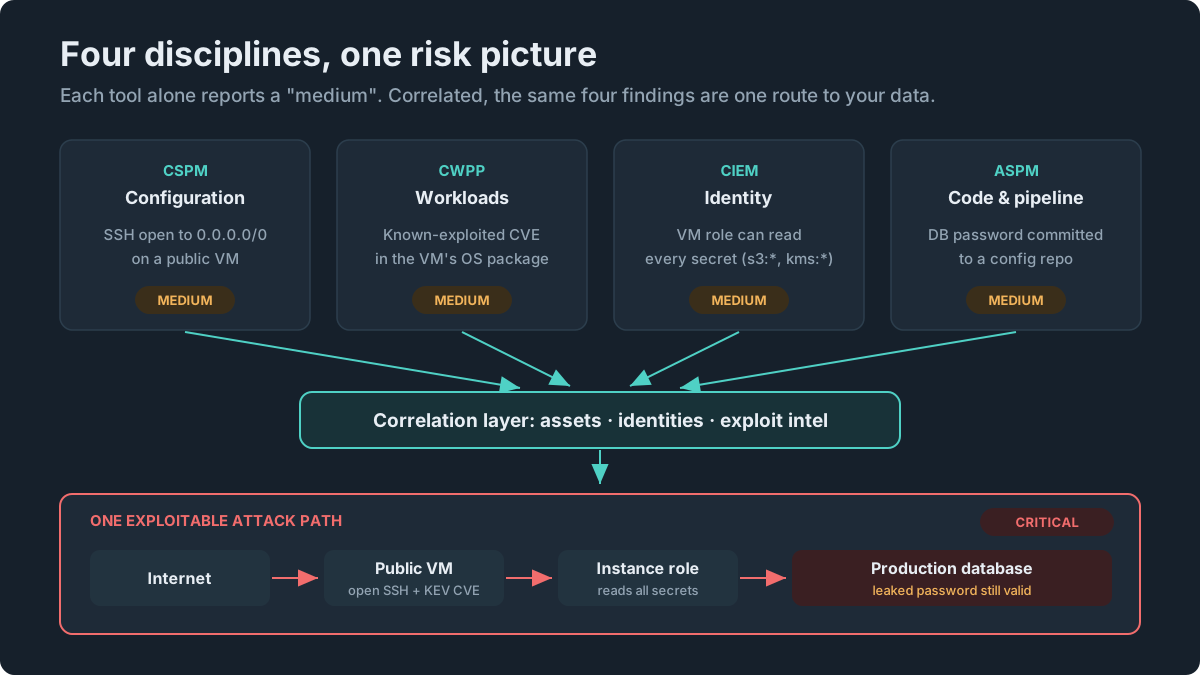
If the acronyms are new to you, our explainer on CSPM vs CNAPP vs CWPP walks through each layer, and what attack path analysis actually does covers the correlation step in depth.
Best CNAPP Tools Comparison Table
| Platform / Vendor | Best Fit For | Industry Rating | Pricing Model | Key Features & Strengths |
|---|---|---|---|---|
| 1. Microsoft Defender for Cloud | Azure-centric & enterprise multi-cloud environments needing native SIEM/XDR integration | 4.4 / 5 on G2 | Tiered & Consumption-Based (Free foundational CSPM, metered CWPP/DevOps) | Native Azure integration, Microsoft Sentinel/XDR correlation, attack path analysis, multi-cloud reach (AWS/GCP) |
| 2. Offload Security | SaaS or on-prem/air-gapped deployment, India regulatory compliance (DPDP, CERT-In, RBI) & scanner aggregation | Newer entrant; not yet rated on G2 | Platform-based licence (SaaS or on-prem); no per-developer or per-scanner fees | SaaS or fully on-prem (air-gapped), unified scanner deduplication (Prowler, Trivy, ZAP), regional compliance automation, threat-informed EPSS/KEV prioritization |
| 3. Wiz | Rapid agentless multi-cloud visibility & graph-based toxic combination analysis | 4.7 / 5 on G2; Forrester Wave Leader (Q1 2026) | Tiered Annual Subscription per monitored cloud workload unit | Agentless Security Graph, rapid API deployment across AWS/Azure/GCP/OCI, toxic combination pinpointing, shift-left IDE/CI-CD guardrails |
| 4. Palo Alto Networks (Prisma Cloud) | Large enterprise full lifecycle code-to-cloud security & in-line container runtime defense | 4.3 / 5 on G2 | Flexible Credit-Based Model allocated across CSPM, CWPP, CIEM, ASPM | Code-to-cloud coverage, in-line container firewalls & runtime defense, Bridgecrew IaC security, 120+ compliance frameworks |
| 5. Banyan Cloud | Multi-cloud posture management & automated misconfiguration remediation playbooks | 4.5 / 5 on G2 | Tiered Enterprise Subscription per monitored account & compute workload | Automated remediation playbooks, real-time posture across AWS/Azure/GCP, continuous SOC 2/PCI-DSS/HIPAA compliance, IaC pipeline scanning |
| 6. Plexicus | Developer-first automated code-level remediation & pull request creation | Highly Rated by DevSecOps Leaders | Per-Developer / Per-Repository Monthly Subscription | Automated GitHub/GitLab PR generation, code-to-cloud vulnerability traceability, function reachability filtering, IDE & CI/CD integration |
| 7. ARMO Platform | Kubernetes-native security, KSPM, and open-source CNCF ecosystem alignment | 4.6 / 5 on G2; Top CNCF KSPM Project | Freemium Open Source (Kubescape); Enterprise billed per cluster/node | Powered by CNCF Kubescape, eBPF runtime threat detection, automated Seccomp & NetworkPolicy generation, K8s RBAC visualizer |
| 8. SecPod Saner CNAPP | Hybrid enterprise endpoint & cloud cyber hygiene with integrated patch management | 4.5 / 5 on G2 | Billed per node/asset per year with modular add-ons | Integrated OS/software patch management, lightweight high-speed asset discovery, unified CSPM/CIEM/CWPP for lean SecOps teams |
| 9. ControlPlane | High-security sectors (finance, defense, public sector) & software supply chain provenance | Renowned for Cloud Security Research & CNCF Leadership | Tailored Enterprise Platform & Managed Defense Subscription | Military-grade threat modeling, supply chain image signing & SBOM auditing, eBPF zero-trust runtime isolation, defense-in-depth hardening |
| 10. Cyscale | European data sovereignty & automated EU regulatory frameworks (GDPR, NIS2, DORA) | Recognized European Cybersecurity Innovator | Tiered Monthly/Annual Subscription per protected cloud asset | Security Knowledge Graph, pre-configured GDPR/NIS2/DORA compliance engines, agentless CSPM/CIEM/DSPM, step-by-step fix recommendations |
Best CNAPP Platforms in 2026
1. Microsoft Defender for Cloud
Microsoft Defender for Cloud is an enterprise-grade CNAPP designed to protect multi-cloud and hybrid environments across Azure, AWS, and GCP. Combining threat intelligence with agentless scanning and optional runtime agents, it provides visibility from code creation to runtime execution.
Key Information
| Category | Details |
|---|---|
| Industry Ratings | 4.4 / 5 on G2 (300+ reviews) |
| Pricing Model | Tiered & Consumption-Based: Foundational CSPM is included free for Azure resources. Advanced features (DevOps security, agentless posture, attack path analysis) and granular CWPP plans (Defender for Servers, Containers, Databases, Storage) are metered per resource/hour. |
Features of Microsoft CNAPP
- Cloud Security Posture Management (CSPM)
- Cloud Workload Protection Platform (CWPP)
- Cloud Infrastructure Entitlement Management (CIEM)
- DevOps Security & ASPM Integration
- Agentless Posture & Vulnerability Scanning
- Attack Path Analysis & Security Graph
- Regulatory Compliance & Governance Mapping
Why Choose Microsoft CNAPP?
- Market Authority & Enterprise-Scale Adoption: Backed by Microsoft's large annual cybersecurity investment and a threat intelligence network processing trillions of daily signals, Defender for Cloud is used by enterprises across the Fortune 500.
- Native Azure Integration with Multi-Cloud Reach: Provides zero-friction deployment natively embedded into Azure infrastructure, while extending standardized policy enforcement, CIS/NIST compliance baselines, and agentless posture management seamlessly across AWS and GCP environments.
- Contextual Intelligence & Industry Recognition: Uses graph analytics, EPSS scoring, and attack path visualization to transform millions of raw telemetry events into actionable, prioritized risk reduction.
- Unified XDR Ecosystem Positioning: Uniquely bridges cloud security operations with Microsoft Sentinel (SIEM/SOAR) and Defender XDR, enabling SOC teams to correlate cloud resource risks with identity, endpoint, email, and SaaS attack vectors from a single operational platform.
Things to Consider
Microsoft Defender for Cloud is a strong fit if your stack is Azure-heavy, but multi-cloud coverage for AWS and GCP is noticeably thinner by comparison. Outside the Microsoft ecosystem, licensing gets complicated fast — most useful capabilities sit behind separate consumption-based billing that's hard to predict at scale. Teams without dedicated Microsoft security expertise also report a steep configuration curve and noisy alerts that require ongoing tuning.
2. Offload Security
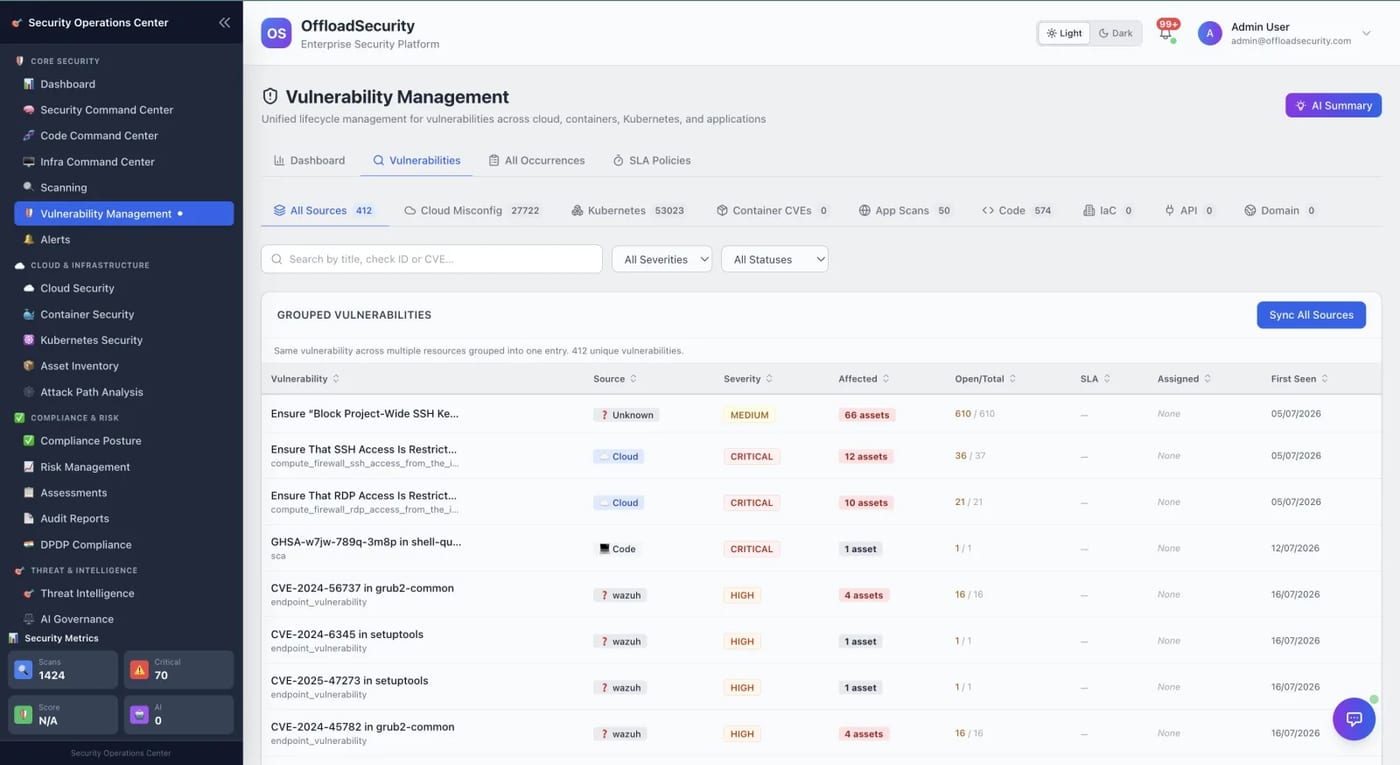
Offload Security is a CNAPP and security orchestration platform for enterprise security teams. By seamlessly bridging Cloud Security Posture Management (CSPM), Kubernetes/container protection, and shift-left Application Security Posture Management (ASPM), Offload Security eliminates security blind spots without introducing vendor lock-in. Available as both SaaS and fully on-premises (including air-gapped) deployment options, it empowers security teams to consolidate tools, automate compliance, and remediate risk with full context.
Key Information
| Category | Details |
|---|---|
| Industry Ratings | Newer entrant, not yet rated on G2. Built for tool consolidation, vulnerability deduplication, and regulatory readiness |
| Pricing Model | Predictable Platform License: Offered as SaaS or fully on-premises (including air-gapped), featuring simple platform-based pricing that scales with environment size and enabled modules rather than charging per-developer or per-scanner fees. |
Features of Offload Security
- Unified Scanner Aggregation & Deduplication
- Flexible SaaS & Fully On-Premises (Air-Gapped) Deployment Options
- Native Regional Regulatory Automation (DPDP Act, CERT-In, RBI, ISO 27001, SOC 2)
- Threat-Informed Prioritization (EPSS, CISA KEV)
- Automated Risk Registers & Compliance Reporting
- Shift-Left Code, IaC & Container Scanning with CI/CD Guardrails
Why Choose Offload Security?
- Flexible SaaS & Fully On-Premises Architecture: Offload Security offers flexible deployment models, allowing organizations to run it as a managed SaaS platform or deploy fully on-premises (including air-gapped environments) to ensure total data residency and sovereign compliance.
- Unified Scanner Aggregation & Vulnerability Deduplication: Eliminates tool sprawl and alert fatigue by acting as a single pane of glass that ingests, normalizes, and deduplicates findings across its built-in and connected scanners (including Prowler, Trivy, OWASP ZAP, OpenVAS, and Wazuh), dramatically lowering the total cost of ownership (TCO).
- Automated Regional Regulatory Engine & Continuous Compliance: Pre-configured with continuous compliance mapping specifically built for stringent regional frameworks (such as India's DPDP Act, CERT-In guidelines, and RBI mandates) alongside global standards (ISO 27001, SOC 2, PCI-DSS, NIST), enabling automated audit preparation and one-click regulatory reporting.
- Threat-Informed Risk Prioritization & Reachability: Correlates findings across posture, identity, and workload layers using EPSS scores, CISA KEV catalogs, and business asset impact matrices to guide engineering teams toward business-critical, actively exploitable attack vectors.
Things to Consider
Offload Security is purpose-built for teams consolidating a fragmented toolset, so organizations looking for a lightweight, single-use point tool may find the platform broader than their immediate needs. The full value becomes apparent once scanner aggregation and compliance automation are running together — teams get the most out of it when they approach it as a platform replacement rather than an add-on.
For detailed feature breakdowns and solution architecture, visit the Offload Security platform page or explore the Offload Security documentation.
3. Wiz
Wiz delivers an agentless, graph-based architecture that provides rapid visibility across AWS, Azure, GCP, OCI, and Kubernetes clusters. Analyzing cloud configurations, network routability, identities, and storage snapshots, Wiz builds a dynamic Security Graph that pinpoints toxic combinations without agents.
Note: In March 2026, Google completed its acquisition of Wiz for $32 billion. Wiz now operates under Google Cloud while maintaining its brand and multi-cloud support across AWS, Azure, OCI, and GCP.
Key Information
| Category | Details |
|---|---|
| Industry Ratings | 4.7 / 5 on G2 (500+ reviews); named a Leader in The Forrester Wave™: Cloud Native Application Protection Solutions, Q1 2026 |
| Pricing Model | Tiered Annual Subscription based on the number of monitored cloud workload units (VMs, containers, serverless functions, database instances). |
Features of Wiz
- Agentless Cloud Security Posture Management (CSPM)
- Security Graph & Attack Path Analysis
- Vulnerability Management & Agentless Workload Scanning
- Cloud Infrastructure Entitlement Management (CIEM)
- Container & Kubernetes Security
- Infrastructure as Code (IaC) Scanning
- Cloud Data Security Posture Management (DSPM)
Why Choose Wiz?
- Market Authority & Enterprise Momentum: Named a Leader in The Forrester Wave™ for CNAPP (Q1 2026) and widely adopted across the Fortune 100, Wiz pioneered the graph-based approach to cloud security.
- Rapid Agentless Deployment & Total Visibility: Achieves 100% multi-cloud coverage within minutes across AWS, Azure, GCP, OCI, and Kubernetes using API connectors and out-of-band VM/storage snapshot scanning without operational overhead or performance degradation.
- Graph Analytics & Toxic Combination Pinpointing: Powers risk correlation through the Wiz Security Graph, exposing complex attack paths by correlating misconfigurations, exposed secrets, high-privilege IAM roles, and active CVEs into an intuitive visual map.
- Developer Democratization & Shift-Left Guardrails: Empowers engineering teams by embedding security checks directly into IDEs, CI/CD pipelines, and pull requests, establishing developer-friendly guardrails that prevent risky infrastructure-as-code from reaching production.
Things to Consider
Wiz's per-workload pricing model scales steeply for large environments, and enterprise contracts tend to require significant negotiation. The platform's strength is agentless visibility; its runtime sensor and active workload-level enforcement are newer and less mature than its posture and graph capabilities. Since Google completed its acquisition in March 2026, organizations with multi-cloud neutrality requirements should factor in potential long-term alignment with Google Cloud.
4. Palo Alto Networks (Prisma Cloud)
Prisma Cloud by Palo Alto Networks – now rebranded and unified as Cortex Cloud – is a mature code-to-cloud CNAPP solution for large-scale enterprise environments. It combines agentless posture scanning with in-line agent runtime defenses, ASPM, CIEM, and cloud data security across multi-cloud topologies.
Key Information
| Category | Details |
|---|---|
| Industry Ratings | 4.3 / 5 on G2 (200+ reviews) |
| Pricing Model | Flexible Credit-Based Model: Customers purchase pool credits that can be dynamically allocated across CSPM, CWPP, CIEM, and DevOps modules as requirements shift. |
Note: Palo Alto Networks rebranded Prisma Cloud as Cortex Cloud in February 2025, merging it with Cortex CDR on the unified Cortex platform.
Features of Prisma Cloud
- Comprehensive Cloud Security Posture Management (CSPM)
- In-Line & Agentless Cloud Workload Protection (CWPP)
- Cloud Infrastructure Entitlement Management (CIEM)
- Application Security Posture Management (ASPM)
- Shift-Left Security & Bridgecrew IaC Protection
- Web App & API Security (WAAS)
- Automated Governance & Compliance Reporting
Why Choose Prisma Cloud?
- Industry-Leading Enterprise Scale & Market Dominance: Trusted by Fortune 100 enterprises globally, Palo Alto Networks' Cortex Cloud (formerly Prisma Cloud) is an established industry benchmark for CNAPP.
- Comprehensive Code-to-Cloud Protection: Delivers full lifecycle security by uniting developer pipeline scanning, open-source dependency auditing, container registry defense, and runtime workload protection under a unified platform framework.
- In-Line Runtime Defenses & Shift-Left Bridgecrew Integration: Combines agentless posture management with active in-line container firewalls and process protection, while leveraging Bridgecrew technology to enforce policy-as-code deep in developer workflows.
- Global Compliance Certifications & Governance Engine: Features over 120 out-of-the-box compliance frameworks (SOC 2, ISO 27001, NIST, HIPAA, PCI-DSS) with automated drift detection and executive reporting tailored for heavily regulated global organizations.
Things to Consider
Cortex Cloud's credit-based pricing is notoriously difficult to forecast, with enterprise tiers running high and costs climbing sharply as environments grow. The ongoing migration from Prisma Cloud to the Cortex platform also introduces real operational disruption — existing users face a near-full platform replacement with its own learning curve and reconfiguration effort. Teams without dedicated Palo Alto expertise routinely cite complex setup and module fragmentation as ongoing friction.
5. Banyan Cloud
Banyan Cloud is an enterprise-grade CNAPP and Cloud Security Management platform engineered for multi-cloud security posture, infrastructure compliance, and shift-left cloud governance. Built to provide continuous automated posture monitoring, identity entitlement enforcement, and proactive misconfiguration remediation across AWS, Azure, and GCP, Banyan Cloud simplifies complex multi-cloud operations into a unified pane of glass.
Key Information
| Category | Details |
|---|---|
| Industry Ratings | 4.5 / 5 on G2; Highly rated for multi-cloud posture management and automated compliance |
| Pricing Model | Tiered Enterprise Subscription based on the number of monitored cloud accounts, compute workloads, and managed cloud resources. |
Features of Banyan Cloud
- Multi-Cloud Security Posture Management (CSPM)
- Cloud Infrastructure Entitlement Management (CIEM)
- Automated Misconfiguration & Drift Remediation
- Continuous Compliance & Governance Automation
- Shift-Left IaC & CI/CD Pipeline Scanning
- Container & Kubernetes Workload Security
Why Choose Banyan Cloud?
- Unified Multi-Cloud Posture & Governance: Delivers real-time posture management across AWS, Azure, and GCP, centralizing security benchmarks, identity entitlements, and policy enforcement into a single operational workflow.
- Automated Remediation Guardrails: Goes beyond passive risk identification by providing automated playbooks and programmatic remediation guardrails that fix misconfigurations before they lead to security incidents.
- Continuous Compliance & Audit Readiness: Pre-configured with comprehensive automated mappings for major global regulatory frameworks (SOC 2, ISO 27001, PCI-DSS, HIPAA, NIST) to eliminate manual audit preparation.
- Shift-Left Infrastructure-as-Code Defense: Integrates directly into CI/CD build pipelines and developer toolchains to scan IaC scripts, catching drift and security gaps prior to production deployment.
Things to Consider
Banyan Cloud is a solid posture and compliance-focused platform, but it is still building its market presence and ecosystem of integrations compared to more established CNAPP vendors. Teams that need mature runtime workload protection or deep Kubernetes-native security as core requirements may find Banyan's current offering better suited as a CSPM and compliance layer than a full-stack CNAPP replacement.
6. Plexicus
Plexicus is a developer-first option among top CNAPP vendors, functioning as both a posture manager and automated remediation engine. By bridging ASPM with live cloud runtime context, Plexicus automatically generates verified code fixes and opens pull requests, allowing engineering teams to resolve vulnerabilities directly in git repositories.
Key Information
| Category | Details |
|---|---|
| Industry Ratings | Highly rated by software engineering and DevSecOps leaders for reducing developer friction |
| Pricing Model | Per-Developer / Per-Repository Monthly Subscription with flexible starter tiers for growth-stage startups. |
Features of Plexicus
- Automated Pull Request Code Remediation
- Application Security Posture Management (ASPM)
- Code-to-Cloud Vulnerability Traceability
- Developer Environment & IDE Integrations
- Reachability & Prioritization Analytics
- Software Bill of Materials (SBOM) Generation
Why Choose Plexicus?
- Developer-First Remediation Positioning: Plexicus bridges SecOps and engineering by automating code-level fixes, directly opening verified GitHub/GitLab pull requests to eliminate manual triage and backlog stagnation.
- Direct Code-to-Cloud Traceability: Traces live cloud runtime vulnerabilities and misconfigurations directly back to specific source code lines, commit histories, and build pipeline configurations.
- Frictionless Workflow Integration: Embeds natively into everyday developer tools (VS Code, GitHub Actions, Jira), empowering software engineers to remediate security risks without leaving their native workspaces.
- Noise Reduction & Function Reachability: Filters out non-reachable code functions and unexecuted open-source dependencies, drastically reducing false positives so developers focus strictly on exploitable code pathways.
Things to Consider
Plexicus is highly specialized around developer-facing remediation and automated pull request generation, which means it functions best as a shift-left ASPM layer rather than a full CNAPP. Organizations looking for broad cloud posture management, runtime workload protection, or compliance reporting will need to pair it with additional tools to cover those gaps.
7. ARMO Platform
ARMO Platform is a Kubernetes-native security solution built on CNCF Kubescape. ARMO combines KSPM, container vulnerability management, eBPF-driven runtime threat detection, and automated network policy generation into a lean operational platform.
Key Information
| Category | Details |
|---|---|
| Industry Ratings | 4.6 / 5 on G2; Top-ranked CNCF open-source KSPM project |
| Pricing Model | Freemium Open Source (Kubescape); Enterprise Tier billed per managed cluster or node per month. |
Features of ARMO Platform
- Kubernetes Security Posture Management (KSPM)
- eBPF-Based Runtime Threat Detection
- Kubernetes RBAC Visualizer & Hardening
- Automated Seccomp & Network Policy Generation
- Image & Container Vulnerability Scanning
- Open-Source Core Powered by CNCF Kubescape
Why Choose ARMO Platform?
- CNCF Ecosystem Leadership & Transparency: Built on top of CNCF Kubescape, ARMO Platform leverages open-source community innovation to deliver transparent, audit-ready Kubernetes security posture management.
- Kubernetes-First Architecture: Tailored specifically for modern container orchestrators, offering deep visibility into K8s RBAC privileges, API server security, and Pod Security Standards (PSS).
- eBPF-Driven Runtime Anomaly Detection: Detects container drift, unauthorized execution of shell binaries, and reverse shell exploits in real time using lightweight kernel instrumentation.
- Automated Cluster Hardening: Observes runtime application behavior to automatically generate Seccomp profiles, AppArmor rules, and zero-trust Kubernetes NetworkPolicies, minimizing manual policy configuration.
Things to Consider
ARMO is purpose-built for Kubernetes environments, which is also its main limitation — organizations running mixed workloads across VMs, serverless functions, or bare-metal infrastructure will find significant coverage gaps outside the container and K8s layer. Teams without existing Kubernetes expertise may also find the open-source Kubescape core and eBPF-based runtime configuration demanding to operate at production scale.
8. SecPod Saner CNAPP
SecPod Saner CNAPP unifies CSPM, CIEM, and CWPP into an automated security suite engineered for fast telemetry, continuous asset discovery, and automated vulnerability management without the overhead of legacy enterprise suites, making it a strong option for lean teams.
Key Information
| Category | Details |
|---|---|
| Industry Ratings | 4.5 / 5 on G2 for vulnerability management and endpoint cyber hygiene |
| Pricing Model | Billed per node/asset per year with modular add-ons for cloud posture and automated patching. |
Features of SecPod Saner CNAPP
- Automated Continuous Asset Discovery
- Integrated Cloud & Endpoint Patch Management
- Cloud Security Posture Management (CSPM)
- Cloud Infrastructure Entitlement Management (CIEM)
- Unified Endpoint & Cloud Cyber Hygiene
- Real-Time Vulnerability & Misconfiguration Scanning
Why Choose SecPod Saner CNAPP?
- Unified Endpoint & Cloud Hygiene Authority: Uniquely bridges cloud security posture management with on-premise servers and enterprise endpoints, extending cyber hygiene across hybrid enterprise environments.
- Integrated Automated Patch Management: Goes beyond passive risk detection by offering built-in patching capabilities that allow SecOps teams to deploy OS and software vulnerability fixes directly from the management console.
- Continuous Rapid Discovery & Low Overhead: Conducts high-speed, lightweight scanning to detect new assets, configurations, and zero-day threats in real time without straining system resources.
- Operational Efficiency for Lean SecOps: Designed for fast time-to-value and low administrative burden, consolidating CSPM, CIEM, and vulnerability management into a single operational interface.
Things to Consider
SecPod Saner CNAPP is best positioned as a hybrid endpoint and cloud hygiene tool rather than a cloud-native CNAPP in the traditional sense. Teams in pure cloud-native environments may find the endpoint-first heritage limiting, and the platform's cloud coverage — particularly around container security, Kubernetes, and advanced attack path analysis — is less mature than dedicated cloud-native competitors.
9. ControlPlane
ControlPlane is a specialized cloud-native security firm and CNAPP innovator built for high-security environments, financial services, and critical infrastructure. Specializing in threat modeling, Kubernetes security engineering, and zero-trust supply chain protection, ControlPlane delivers hardened security architectures across complex multi-cloud and hybrid infrastructures.
Key Information
| Category | Details |
|---|---|
| Industry Ratings | Renowned for cloud-native security research, threat modeling leadership, and CNCF ecosystem contributions |
| Pricing Model | Tailored Enterprise Platform & Managed Defense Subscription based on cluster volume, infrastructure complexity, and security scope. |
Features of ControlPlane
- Kubernetes & Cloud Posture Hardening
- Software Supply Chain Attestation & Provenance Verification
- Threat Modeling & Attack Path Analysis
- Zero-Trust Runtime Isolation Guardrails
- Continuous Compliance & Defense-Grade Security Benchmarking
- Container Image Signing & SBOM Auditing
Why Choose ControlPlane?
- Extreme Hardening for High-Regulated Sectors: Engineered specifically for mission-critical banking, defense, and public sector organizations that require defense-in-depth isolation and military-grade threat modeling.
- Kubernetes-Native Security & Supply Chain Provenance: Provides end-to-end software supply chain security, cryptographically verifying container image provenance, SBOMs, and build attestations before runtime execution.
- Threat-Informed Zero-Trust Architecture: Leverages advanced continuous threat analysis to continuously validate cluster posture, RBAC policies, and runtime isolation boundaries against active adversary tactics.
- CNCF Ecosystem Thought Leadership: Directly contributes to Kubernetes security standards and open-source tooling, offering deep expertise and audit-grade posture validation.
Things to Consider
ControlPlane operates primarily as a boutique security consultancy and engineering firm rather than a productized self-service platform, which means procurement, deployment, and ongoing operations typically require direct engagement with their team. Organizations expecting a plug-and-play CNAPP with a standard SaaS trial experience will find the ControlPlane model a poor fit — it is best suited for high-security, high-budget environments willing to invest in a tailored engagement.
10. Cyscale
Cyscale is an agentless risk-intelligence platform built to turn cloud security data into actionable priorities. Establishing a Security Knowledge Graph, Cyscale connects cloud posture, identity permissions, data protection, and regulatory compliance into streamlined workflows.
Key Information
| Category | Details |
|---|---|
| Industry Ratings | Recognized European cybersecurity innovator with strong GDPR and NIS2 compliance capabilities |
| Pricing Model | Tiered monthly or annual subscription based on the total number of protected cloud assets (VMs, storage buckets, database instances). |
Features of Cyscale
- Security Knowledge Graph Analysis
- Agentless Cloud Security Posture Management (CSPM)
- Cloud Infrastructure Entitlement Management (CIEM)
- Data Security Posture Management (DSPM)
- Pre-Configured EU GDPR & NIS2 Regulatory Frameworks
- Step-by-Step Contextual Remediation Guidance
Why Choose Cyscale?
- European Data Sovereignty & Privacy Leadership: Engineered in full alignment with strict EU data protection regulations, making Cyscale a top choice for European businesses and multinational corporations with cross-border compliance mandates.
- Out-of-the-Box GDPR & NIS2 Regulatory Automation: Features pre-configured compliance engines specifically targeted at European cybersecurity mandates (GDPR, NIS2, DORA) alongside global standards like ISO 27001, SOC 2, and CIS benchmarks.
- Contextual Knowledge Graph Risk Analysis: Maps complex relationships between IAM roles, internet-exposed endpoints, storage bucket permissions, and vulnerabilities to expose hidden attack paths.
- Streamlined Contextual Remediation Workflows: Provides clear, step-by-step fix recommendations and automated remediation guidance, enabling compact security teams to address root-cause risks efficiently.
Things to Consider
Cyscale is a strong fit for European compliance requirements but has a narrower global compliance library compared to enterprise incumbents like Prisma Cloud or Microsoft Defender for Cloud. The platform also lacks native runtime workload protection and container security depth, meaning organizations that need active threat defense beyond agentless posture and DSPM will likely need supplementary tooling alongside it.
How to Choose the Best CNAPP Software for Your Organization
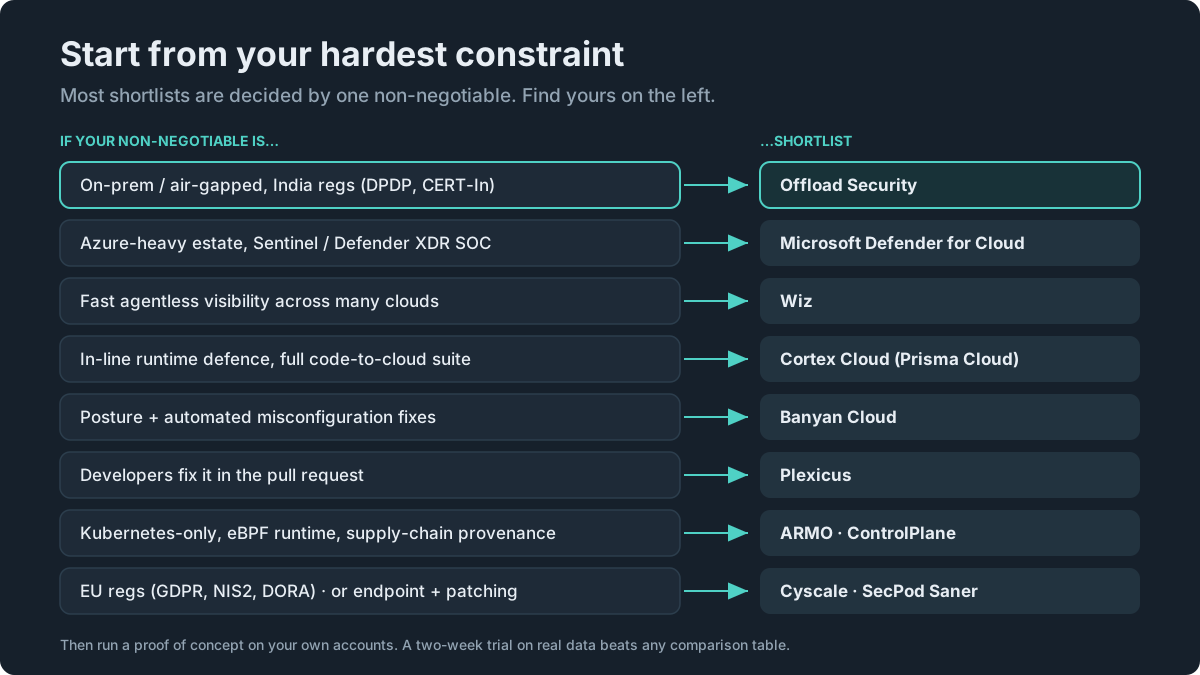
Selecting from the best CNAPP platforms depends on your infrastructure architecture, team size, deployment requirements, and regulatory obligations:
- For Full On-Premises & Data Sovereignty Control: Choose Offload Security. It provides complete fully on-premises (including air-gapped) deployment options, scanner aggregation, and deep compliance engines tailored for regulated industries and sovereign cloud requirements.
- For Azure-Centric Enterprise Ecosystems: Choose Microsoft Defender for Cloud. Its native integrations with Azure Policy, Sentinel, and Defender XDR offer seamless protection for Microsoft-heavy stacks.
- For Enterprise Runtime Protection & Full Lifecycle Coverage: Choose Palo Alto Networks (Prisma Cloud). It delivers deep, in-line container and host runtime defenses across code, build pipelines, and production environments.
- For Developer-Centric Automated Remediation: Choose Plexicus. Its focus on automatically opening pull requests and providing code-level fixes reduces friction between Dev and Sec teams.
- For Kubernetes-Native eBPF Zero-Trust & Hardened Security: Choose ARMO Platform or ControlPlane. Their platform capabilities deliver continuous posture management, supply chain provenance, and advanced runtime protection for containerized and multi-cloud workloads.
Conclusion
The evolution of cloud security marks a fundamental shift from fragmented, siloed point tools toward unified Cloud-Native Application Protection Platforms. As enterprise architectures increasingly rely on multi-cloud environments, modern microservices, and rapid CI/CD deployment pipelines, relying on isolated security controls creates critical operational blind spots and severe alert fatigue. A well-implemented CNAPP harmonizes posture management, workload protection, entitlement governance, and developer security into a cohesive operational view.
When charting your organization's cloud security roadmap, decision-makers must evaluate CNAPP platforms against four key strategic pillars:
- Comprehensive Multi-Cloud Visibility: Ensuring agentless and continuous posture discovery across all public cloud providers, private infrastructure, and containerized environments.
- Real-Time Runtime Protection: Extending protection beyond static configuration scans to include active, eBPF-driven or agent-based kernel runtime threat detection and automated micro-segmentation.
- Shift-Left ASPM & Developer Workflows: Embedding security policies early into IaC templates, container registries, and IDEs to remediate risks before code reaches production environments.
- Data Sovereignty & Regulatory Compliance: Aligning architecture deployment choices—whether public cloud SaaS, hybrid, or 100% air-gapped self-hosted—with stringent local regulatory frameworks and data privacy mandates.
Ultimately, choosing the right platform requires aligning technical capabilities with your organization's operational maturity, existing DevSecOps workflows, and regulatory footprint. Security leaders must move away from chasing raw alert volume and instead focus on threat-informed risk prioritization.
By selecting a CNAPP solution that pinpoints realistic attack paths and integrates seamlessly into engineering operations, enterprises can achieve robust cloud governance, accelerate software delivery, and maintain resilient posture across any cloud environment.
If on-prem deployment or India's regulatory stack is on your shortlist criteria, see how Offload Security maps to DPDP, CERT-In and RBI requirements, or read our head-to-head comparisons.