
Open any cloud security tool and the first thing it shows you is a number. Thousands of findings. Hundreds of them "high." A backlog no team could clear in a year, sorted by a severity score that treats every issue as if it existed in isolation. So you patch the criticals, close some tickets, and the number barely moves — because the score never told you which of those findings an attacker could actually use.
This is the gap attack path analysis closes. Instead of ranking weaknesses one at a time, it asks a different question: starting from where an attacker could get in, what is the actual sequence of steps that reaches something valuable? The answer is almost never your longest list of criticals. It is a short, specific chain — and fixing one link in it often matters more than closing a hundred unrelated tickets.
Why a severity score isn't a priority
Severity scores like CVSS describe a weakness in the abstract: how bad would this be if it were exploited under worst-case conditions? That is useful information, but it is not prioritization, because it ignores context. A critical vulnerability on an isolated host with no sensitive data and no network reachability is, in practice, a low priority. A medium-severity misconfiguration on an internet-facing box that holds credentials to your production database is an emergency.
Traditional tools can't tell those two apart, so they fall back on the score and hand you a list. The result is the familiar failure mode: alert fatigue, a backlog sorted by the wrong key, and real exposures buried among thousands of technically-valid-but-unreachable findings.
What attack path analysis actually does
Attack path analysis models your environment as a graph, not a list. Cloud resources, identities, permissions, workloads, and their relationships become nodes and edges. On top of that graph, the analysis reasons about how an attacker moves — the same techniques catalogued in frameworks like MITRE ATT&CK: initial access, then lateral movement, then privilege escalation, then access to data.
Each edge represents something an attacker could do: this public server is reachable from the internet; this vulnerability is exploitable; this compromised host can assume that IAM role; that role can read the production database. String the edges together and you have a path — a concrete, walkable route from an entry point to a target. The tool's job is to find those routes and rank them by what they reach, not by the severity of any single hop.
From a list of alerts to a walkable route
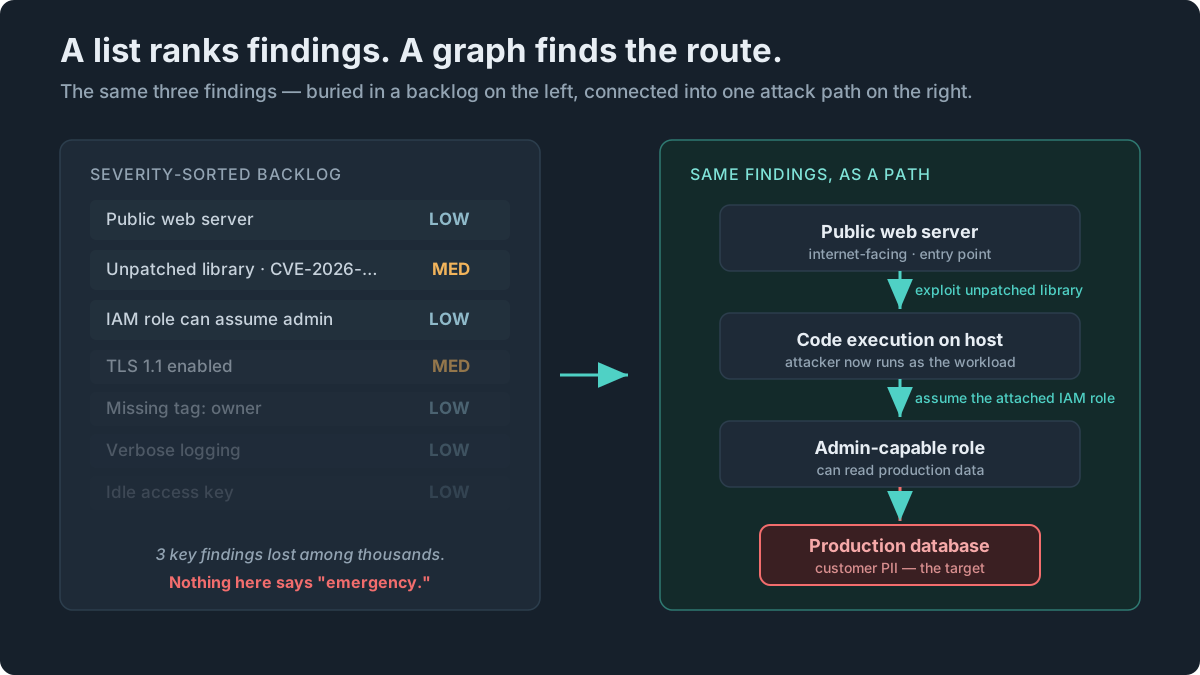
Consider a realistic example. Your scanner reports three findings, and left to its own devices it would rate all three somewhere between low and medium:
- A web server exposed to the internet — low, it's supposed to be public.
- An unpatched library on that server — medium, one of hundreds of CVEs this week.
- An IAM role attached to the server that can assume broader permissions — low, over-provisioning is everywhere.
Individually, each of these gets lost in the noise. But the graph sees that they connect: the public server can be reached, the library gives an attacker code execution on it, and the role that server carries opens a door to the database holding customer data. Three forgettable findings are actually one critical attack path — and no severity score on any single finding would have surfaced it.
Choke points: fix once, break many paths
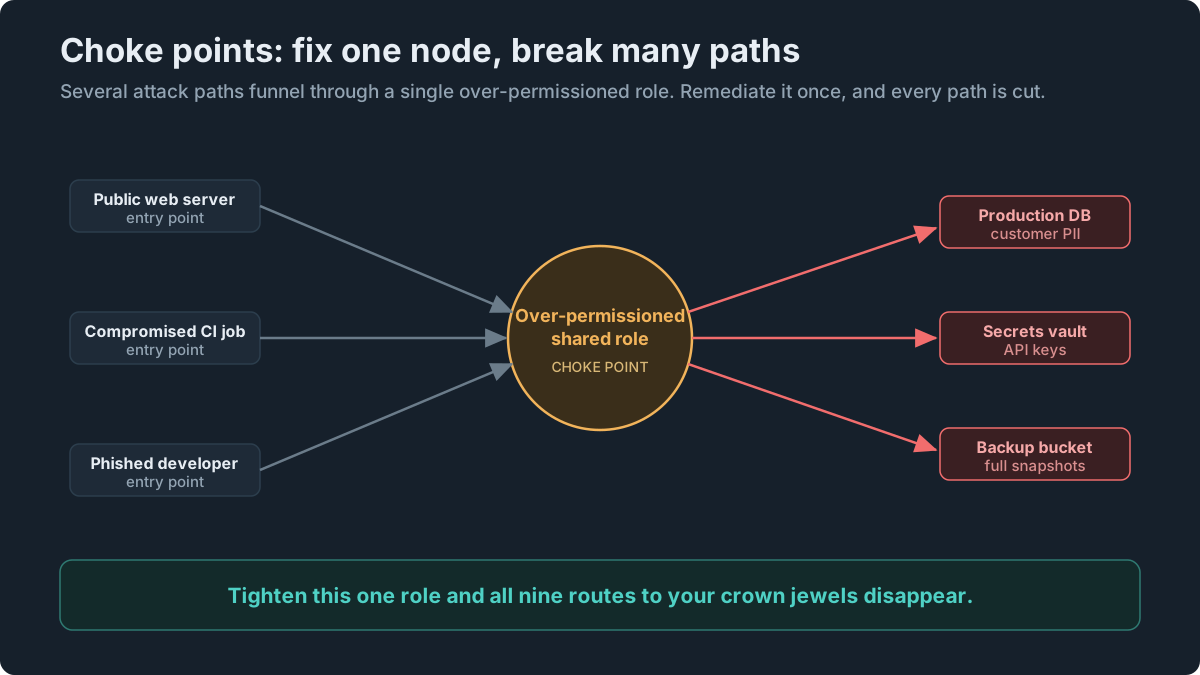
The graph view unlocks something a list never can: it shows you where paths converge. In most environments, a handful of nodes sit on a large fraction of the dangerous routes — an over-permissioned role that many workloads can assume, a shared secret, a flat network segment. These are choke points.
Remediating a choke point is high-leverage in a way that clearing individual findings never is: tighten that one over-permissioned role and you may sever dozens of distinct attack paths at once. Attack path analysis makes this measurable — you can rank fixes not by how many tickets they close, but by how many routes to your crown jewels they eliminate. That is a fundamentally better use of a security team's limited time.
Identity is the connective tissue
Most real cloud attack paths are not a chain of software exploits — they run through identity. An attacker rarely needs a zero-day when a compromised workload carries a role that can assume another role that can read a bucket. Permissions are the edges that turn isolated weaknesses into a path.
This is why an attack path is only as good as the identity data underneath it. A tool that understands who can do what to which resource — across human users, service accounts, and machine identities — can trace routes that a purely vulnerability-focused scanner is blind to. Attack path analysis and cloud identity analysis (sometimes marketed as CIEM) are really two views of the same graph, which is one reason both have been absorbed into consolidated platforms rather than left as point tools. We covered how these categories fit together in CSPM vs CNAPP vs CWPP.
What good attack path analysis looks like
Not every "attack path" feature is equally useful. When you evaluate one, look for:
- Identity awareness — does it reason about roles, permissions, and trust relationships, or only about network reachability and CVEs? Identity is where the real paths live.
- Choke-point analysis — does it tell you which single fixes break the most paths, or just draw pretty graphs?
- Remediation simulation — can it show you, before you touch anything, which paths a proposed fix would eliminate?
- Breadth of the graph — does it span cloud, workloads, and on-prem, or stop at the edge of one cloud account? Attackers don't respect those boundaries.
Turning the graph into fewer, better fixes
The promise of attack path analysis is not more dashboards — it is less work that matters more. A shorter list, ordered by real exploitability, with the highest-leverage fixes at the top.
The Offload Platform builds this graph across cloud configuration, workloads, code, and identity — spanning cloud and on-prem — and surfaces the choke points where one change severs many routes to your data. If you're weighing platforms on how well they prioritize rather than how many findings they generate, our comparisons are a good place to start. The goal is the same one every overloaded security team is chasing: stop working the list, and start cutting the paths.