
Choosing the wrong cloud security platform can leave an organization in a worse position than before the purchase. The security team gains another console, developers receive another stream of alerts, and executives still cannot answer a basic question: which cloud risks could cause material damage now?
The cost reaches beyond software fees. A poor choice consumes implementation time, slows engineering teams, leaves coverage gaps, and creates false confidence for leadership and auditors.
When evaluating how to choose a CNAPP solution, a strong decision starts with the organization's risks and operating capacity, then tests whether a platform can turn scattered technical signals into a small number of actions that people can own.
Decide Whether You Need a CNAPP
A cloud-native application protection platform, or CNAPP, brings several cloud security functions into one operating model. These commonly include cloud configuration checks, workload protection, Kubernetes security, cloud identity analysis, code and software supply chain scanning, compliance monitoring, and risk prioritization.
Gartner's current guidance identifies cloud security posture management (CSPM), cloud workload protection (CWPP), Kubernetes security posture management (KSPM), and cloud infrastructure entitlement management (CIEM) as core capabilities. If those acronyms blur together, our explainer on CSPM vs CNAPP vs CWPP walks through each layer.
The case for CNAPP becomes stronger as the distance grows between the people who build services and the people expected to secure them. Warning signs include several cloud providers, frequent production releases, Kubernetes or serverless workloads, overlapping scanners, manual compliance work, and a backlog that nobody can confidently prioritize. Companies also reach the point of need when they cannot connect a vulnerable software package to the application using it, the owner responsible for it, or the business service at risk.
Smaller organizations may not need a full platform yet. A company with one cloud, a limited number of workloads, and a capable internal team may cover its immediate risks with the cloud provider's native controls and a few focused tools. The decision should reflect complexity rather than company size alone. A 40-person software company operating hundreds of short-lived workloads may have a harder security problem than a much larger business running a stable internal system.
Leadership should also assess operational readiness. A platform can identify risk, yet someone must accept findings, fund remediation, and measure closure. When ownership is unclear, a CNAPP can make the backlog more visible without making the company safer.
Define the Outcome Before Comparing Products
Vendor comparisons often begin with feature lists. A better starting point is a set of business questions the platform must answer. Executives should expect clear answers to questions such as:
- Which weaknesses are exposed to the internet or reachable from an untrusted path?
- What is the potential blast radius if a specific identity is compromised?
- Which issues affect critical services or sensitive data?
- Which identities hold more access than their role requires?
- Which vulnerabilities are known to be exploited or are likely to be exploited soon?
- Who owns each affected application, and how quickly can the issue be corrected?
- Can the company show auditors that controls are operating in the live environment?
Risk prioritization deserves particular attention. A severity score alone says little about the organization's actual exposure. The US Cybersecurity and Infrastructure Security Agency maintains the Known Exploited Vulnerabilities (KEV) catalog to identify vulnerabilities with evidence of exploitation. FIRST's Exploit Prediction Scoring System (EPSS) estimates the probability that a published vulnerability will be exploited in the next 30 days.
A useful CNAPP combines signals such as these with internet exposure, access permissions, workload status, data sensitivity, and business importance. The result should be an ordered remediation plan rather than a longer findings report.
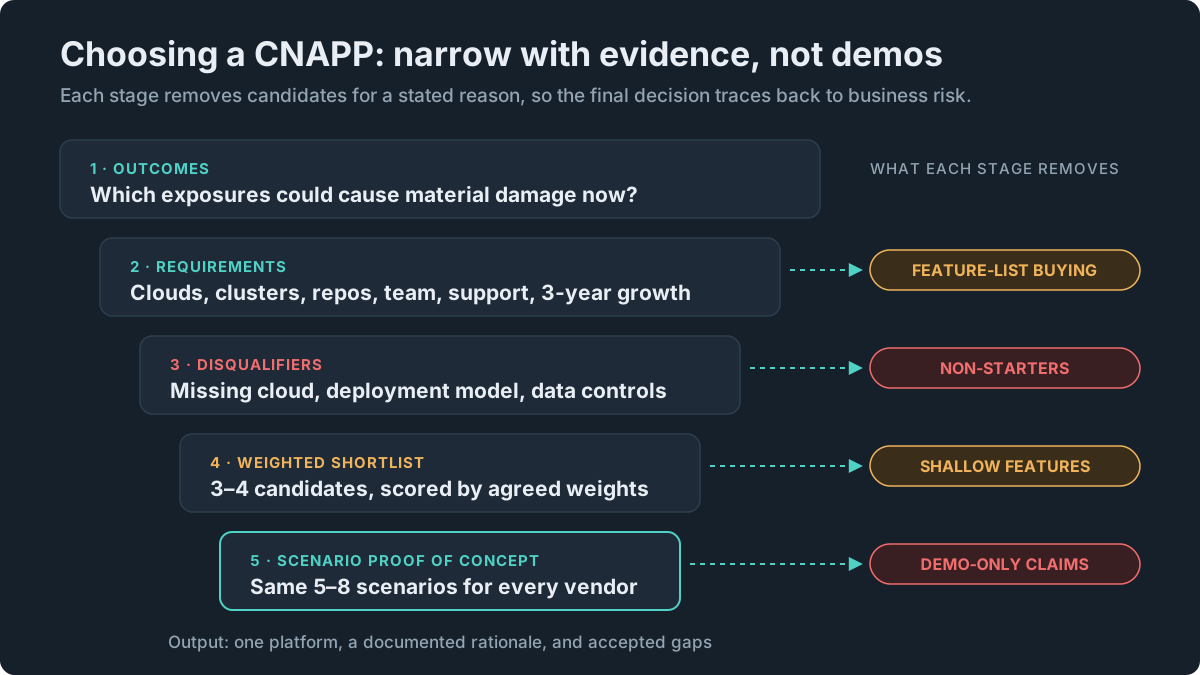
Set Requirements Around Your Organization
Requirements should reflect the environment the platform will protect over the next two or three years. Record the cloud providers, accounts, subscriptions, clusters, registries, repositories, deployment pipelines, applications, APIs, identities, and compliance obligations in scope. Growth plans matter because pricing and performance can change sharply as new accounts or workloads are added.
Deployment architecture: agentless vs. agent-based
The way a CNAPP gathers data dictates its impact on engineering velocity.
- Agentless scanning: Uses API connections and cloud volume snapshots to scan infrastructure without installing software on the workloads. This provides fast coverage with negligible performance impact, which suits CSPM and baseline vulnerability scanning.
- Agent-based / eBPF: Requires installing lightweight sensors (often built on eBPF) on the workload. This is needed for real-time cloud detection and response (CDR) and for stopping active runtime threats (CWPP).
A modern CNAPP should offer a hybrid approach to balance frictionless visibility with deep runtime protection.
Shift-left vs. shield-right
Security must cover the entire application lifecycle. Shift-left capabilities require integrating into the developer's CI/CD pipeline (scanning infrastructure as code, generating SBOMs). Shield-right requires robust runtime defense. Your CNAPP must bridge the gap, tracing a live production threat back to the specific repository that caused it.
Team structure shapes the choice as much as technology
A small security group supporting many developers needs straightforward deployment, reliable automation, and strong vendor assistance. A large enterprise may place greater value on custom policies, delegated administration, data residency, and integration with existing security operations.
AI use creates another requirement category
Companies using AI to generate code need controls that fit the normal software review process. Organizations operating models, agents, or AI services may also need asset discovery, model governance, testing for AI-specific attacks, and visibility into sensitive data access.
NIST's secure development guidance for generative AI, SP 800-218A, extends established software security practices across the AI development lifecycle. Buyers should therefore ask how a CNAPP covers AI systems, where its own AI features process customer data, and whether people can review automated recommendations before action.
Support needs should be explicit
Some teams need product documentation and a standard service desk. Others need onboarding, architecture reviews, remediation guidance, compliance assistance, or ongoing monitoring. The proof of concept should test the quality of support with real cases, including the route to an experienced engineer when the first response does not solve the problem.
Require a Connected View of Risk
A credible CNAPP should cover the application lifecycle and preserve context between code and production. It should discover cloud assets, assess configurations and permissions, examine software and infrastructure code, protect relevant workloads, and connect findings to applications and owners. Coverage must match the organization's real mix of virtual machines, containers, Kubernetes, serverless services, APIs, and cloud providers.
- Correlated, not siloed. Older tools present risks in silos: one alert for an exposed S3 bucket, another for an over-privileged IAM role. Modern CNAPPs use a unified graph to identify toxic combinations, multi-step attack vectors where low-level misconfigurations chain together. This is known as attack path analysis. If a platform cannot show how an attacker could move from a vulnerable VM through a service account to sensitive data, it lacks a connected view.
- Integration quality. Most remediation occurs outside the security console. Verify that findings can reach the ticketing, development, messaging, and security operations systems teams already use. Each ticket should carry enough evidence and guidance for the owner to act without repeating the investigation.
- Reporting from one source of truth. Good reporting serves different decisions from the same underlying data. Executives need trends, material exposure, accountability, and exceptions. Security teams need evidence and investigation context. Developers need a reproducible problem and a practical fix. Auditors need control status tied to current technical evidence. A platform that produces separate and inconsistent versions of the truth will recreate the fragmentation it was purchased to remove.
- Governed automation and AI. Automation and AI can reduce manual effort when their output is explainable, reviewable, and governed. Buyers should test the accuracy of summaries, ownership suggestions, remediation guidance, and automated changes. A polished assistant cannot compensate for incomplete asset discovery or weak risk context.
- Adjacent capabilities on merit. Data security posture management (DSPM), API testing, software bills of materials (SBOMs), license governance, and AI security may add significant value. Their importance depends on the company's products, data, regulations, and existing tools. Treat them as requirements only when they address a defined risk or replace a real cost.
Choose an Operating Model You Can Sustain
Native cloud security services often suit organizations concentrated in one provider. They may offer fast access to provider-specific telemetry and simpler procurement. Their value can decline when leadership needs consistent policy, reporting, and prioritization across several clouds and development systems.
- Open-source tools make sense when the organization has the skill and time to build its own operating layer. License cost is only one part of the calculation. Engineering work is required to deploy scanners, normalize findings, maintain integrations, tune policies, operate infrastructure, produce reports, and respond when components change. Open source can offer control and transparency, especially for narrowly defined requirements, provided the company accepts those responsibilities.
- Commercial software as a service (SaaS) usually provides faster onboarding, managed updates, elastic capacity, and vendor support. Buyers should examine data location, access permissions, retention, service availability, export options, and the process for removing the vendor's access.
- Commercial, self-hosted. Regulated companies may prefer a commercial platform deployed fully in their own environment. That model can preserve data control while retaining product support, although the customer may assume more operational work.
Compare the three-year total cost of each model. Include licenses, cloud infrastructure, implementation, maintenance, integrations, training, support, and the people required to operate it. Expected value should include retired tools, reduced triage effort, faster remediation, shorter audit preparation, and lower exposure to serious incidents.
Shortlist CNAPP Tools With Evidence
Begin with five to eight scenarios drawn from your environment. One scenario might ask the platform to find an internet-facing production workload with a vulnerability in the CISA KEV catalog, trace it to its source repository, identify its owner, and open a ticket with a validated fix. Another might test whether an overprivileged identity can reach sensitive data.
Set disqualifying conditions before vendor meetings. Missing support for a required cloud, an unacceptable deployment model, weak data controls, unpredictable pricing, or an essential integration gap should remove a product from consideration. Shortlist three or four candidates that pass these conditions. Our buyer's guide to the top CNAPP tools is a reasonable place to build the initial long list.
Score them using weights agreed by security, engineering, compliance, procurement, and business owners. The following allocation provides a practical starting point. Adjust it to match the organization, because a regulated bank and a growing SaaS company should not produce identical scorecards.
| Evaluation area | Starting weight | Focus |
|---|---|---|
| Required coverage | 20% | Multi-cloud, Kubernetes, serverless, APIs, AI |
| Risk prioritization | 15% | Attack paths, toxic combinations, KEV, EPSS |
| Integrations | 15% | CI/CD, ticketing (e.g. Jira), SIEM |
| Remediation | 10% | Automated fixes, developer context |
| Deployment controls | 10% | Agentless and agent-based (eBPF) options |
| Usability & total cost | 30% | Licensing, scalability, reporting, support |
Make the Proof of Concept Decisive
Run the same tests for every shortlisted platform using representative accounts, applications, and workflows. Define success before testing. Useful measures include:
- Percentage of expected assets discovered
- Duplicate and false-positive rates
- Time needed to identify an owner
- Time from detection to verified correction
- Integration effort and developer acceptance
- Reporting time saved
Require vendors to explain missed assets, unusual permissions, and scoring decisions. Test removal as carefully as onboarding so the team knows which agents, roles, connectors, and retained data will remain if the platform is rejected.
Several common mistakes disappear under a disciplined proof of concept. Buyers avoid choosing from a controlled demo, counting features without checking their depth, assuming every listed integration is ready, and accepting AI claims without testing accuracy or data handling.
Support should also be evaluated during the trial, because its quality can determine whether a small team succeeds with a broad platform.
Frequently Asked Questions
What is the difference between CSPM and CNAPP?
CSPM (cloud security posture management) is a foundational subset of a CNAPP. CSPM checks cloud infrastructure for misconfigurations. A CNAPP combines CSPM with workload protection (CWPP), identity and entitlement management (CIEM), and code-level scanning into a single, correlated platform.
Do I need an agentless or agent-based CNAPP?
Ideally, both. Agentless scanning suits fast, low-friction deployment and broad visibility across accounts. Stopping active threats in real time (runtime protection), however, requires lightweight, often eBPF-based agents installed on critical workloads.
How does a CNAPP help with developer friction?
By consolidating multiple security scanners into one correlated data model, a CNAPP deduplicates alerts. Instead of sending developers three separate tickets for the same underlying issue, it correlates the data and provides a single ticket with exact context.
Making a Defensible Decision
The right CNAPP is the one your organization can operate and use to reduce important risk. Leadership should be able to trace the final decision from business risks to requirements, proof-of-concept evidence, ownership, cost, and accepted gaps.
Start by documenting the environment and the few security outcomes that matter most. Choose the operating model your team can sustain, eliminate candidates that fail essential conditions, and test the remaining platforms against identical scenarios. A decision made this way gives executives more than a security product. It gives them a measurable program for finding risk, assigning responsibility, and verifying that exposure is falling.
Where Offload Security Fits
Offload Security is a unified CNAPP, vulnerability management and compliance platform, with the option of expert support. Its published capabilities cover cloud posture, code, containers, Kubernetes, vulnerability management, attack-path analysis, threat intelligence, compliance, AI security, and reporting through one normalized data model. The platform is available as SaaS or fully on-premises.
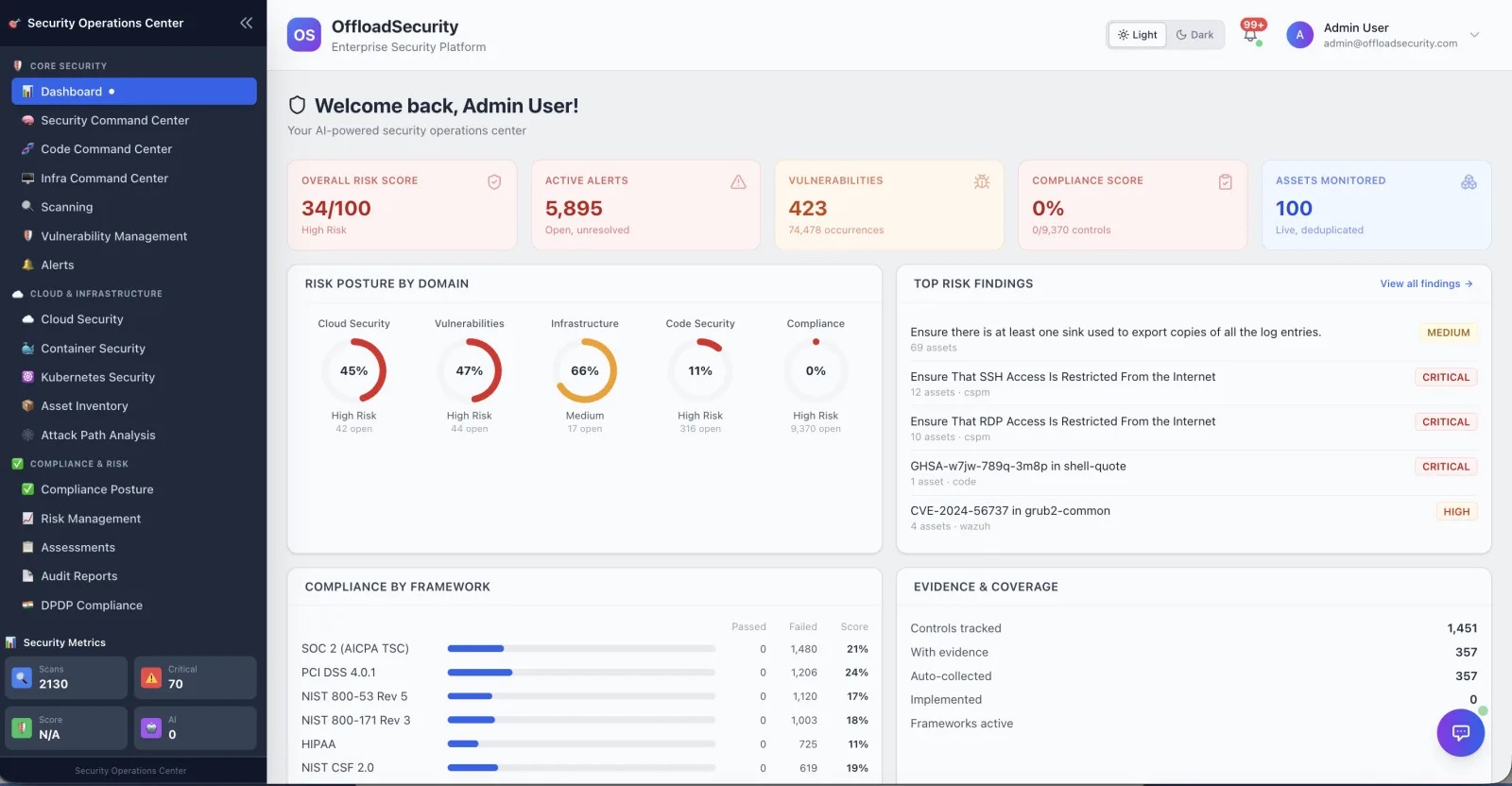
Offload also enriches findings with CISA KEV and EPSS information, links technical findings to compliance and risk workflows, and offers security assessment, implementation, and ongoing service options. Its platform licensing is scoped to the environments connected rather than developer seats, which may be useful for organizations with broad development participation.
Those capabilities should be judged through the exact process outlined above. A tailored proof of concept should confirm coverage, prioritization, integrations, remediation quality, deployment requirements, support, and total cost in your environment. See our head-to-head comparisons, or book a 30-minute demo to see how a unified CNAPP handles your specific cloud risks.