
Attack Path Analysis
See how an attacker chains exposure, identity, and privilege to reach what matters.
What is attack path analysis, and how does Offload Security do it?
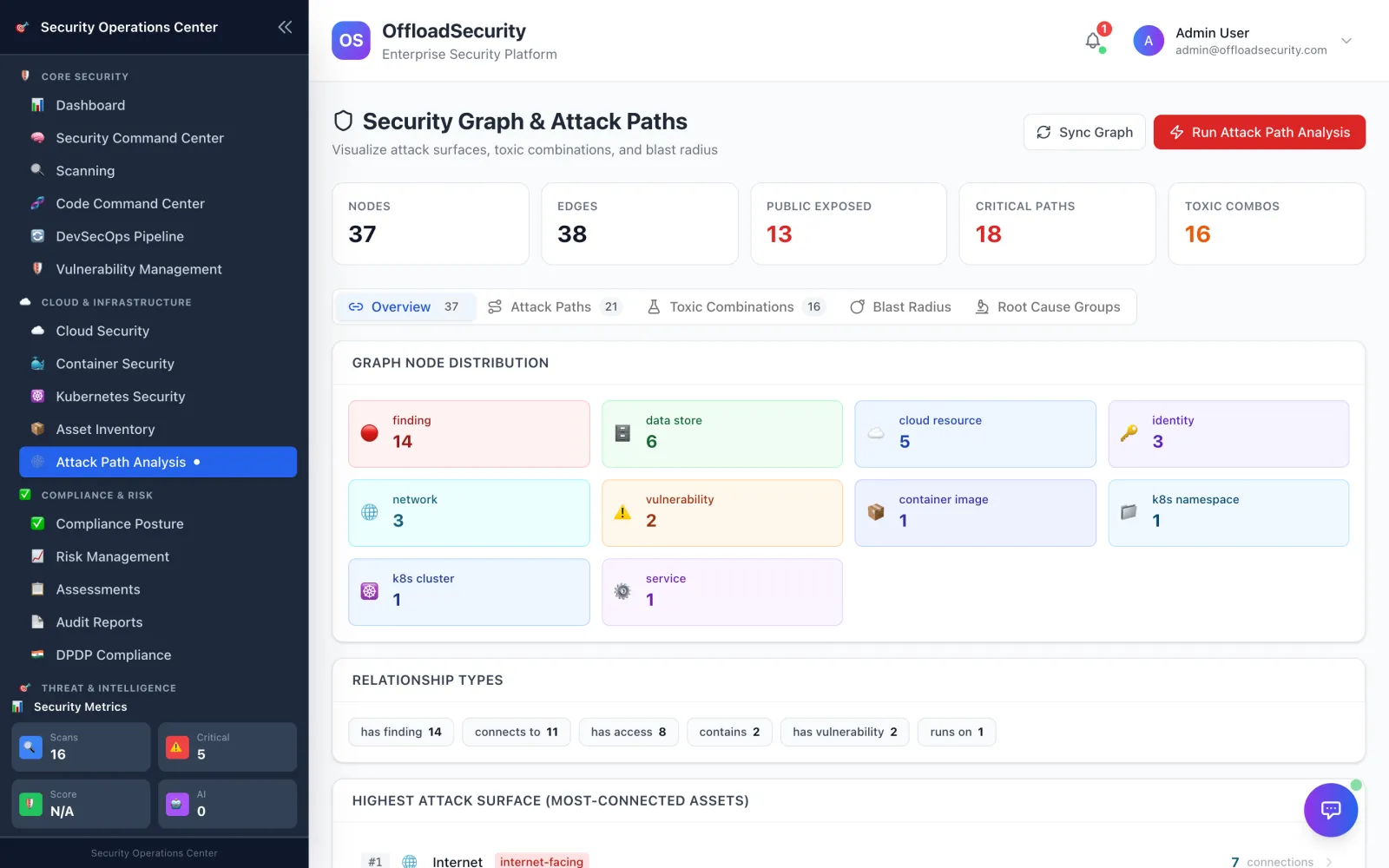
A graph engine that connects internet exposure, cloud resources, identities, and privilege-escalation relationships into traversable attack paths — then ranks them by what they reach and shows the fewest fixes that break the most paths.
Attack Path Analysis in the Offload Platform
What this replaces
A list of thousands of findings can't tell you which three, chained together, actually reach a sensitive data store. Severity alone misses the combination; the risk lives in the path, not the point.
What Offload does
A graph engine that connects internet exposure, cloud resources, identities, and privilege-escalation relationships into traversable attack paths — then ranks them by what they reach and shows the fewest fixes that break the most paths.
What you get
- Breadth-first path traversal over a unified security graph — network, identity, and privilege-escalation edges
- Identity-aware: has-access and can-escalate-to edges derived from IAM analysis (admin and over-privileged principals)
- Toxic-combination rules mapped to MITRE ATT&CK
- Crown-jewel tiering so paths are ranked by the value of what they reach, not just finding severity
- Choke-point analysis: the edges that, cut, break the most critical paths
- Remediation simulation: model 'if we fix these, critical paths drop from N to M' before committing
- Hybrid cloud + on-premises graph — internet, cloud workloads, and Wazuh-discovered on-prem hosts in one model
How it works
Cloud assets, findings, identities, and on-prem hosts are ingested into one graph. Identity edges are derived from IAM analysis — an admin or over-privileged principal is linked to the data stores it can reach and the admins it can escalate into.
Path enumeration runs breadth-first from internet-exposed entry points to high-value targets, then analytics rank paths, surface choke points, and simulate remediation. Identity edges are relationship-derived heuristics, not per-resource policy simulation — designed to surface real chains for review, not to replace an IAM policy evaluator.
One platform, one risk view
Attack paths draw on the same cloud, Kubernetes, and identity data as the rest of the platform, and feed path context into the risk register — one graph over everything already scanned.
Ready to implement it?
Step-by-step guides in the product documentation — every connection is read-only, with copy-paste setup.
Solutions built on Attack Path Analysis
Banking & Financial Services
Consolidate cloud, code, container and Kubernetes risk into one governed view, map it live to the frameworks your auditors and regulators expect, and keep regulated data in your own environment — with a native DPDP Act and CERT-In breach module built for India.
Robotics, Logistics & Manufacturing
Cloud workloads, on-premises infrastructure and embedded software supply chains — unified in one governed risk view, with Wazuh/SIEM integration for the operational side and full on-premises deployment for air-gapped environments.
Replace the risk spreadsheet
Score risk on CVSS, EPSS, KEV and business impact, and let risks open and close with the findings beneath them — so the register reflects reality between board meetings, not just before them.
Other modules on the platform
Attack Path Analysis — frequently asked questions
How does Offload Security identify attack paths?
A graph engine connects internet exposure, cloud resources, identities and privilege-escalation relationships, then runs breadth-first traversal from internet-exposed entry points to crown-jewel assets to surface real, chainable paths.
Can Offload show which fixes break the most paths?
Yes — choke-point analysis identifies the edges that, cut, break the most critical paths, and remediation simulation models how many critical paths a set of fixes would eliminate before you commit.
Does attack path analysis cover on-premises?
Yes — it builds one hybrid graph across internet, cloud workloads and Wazuh-discovered on-prem hosts. (Identity edges are relationship-derived heuristics to surface chains for review, not a full IAM policy simulator.)